
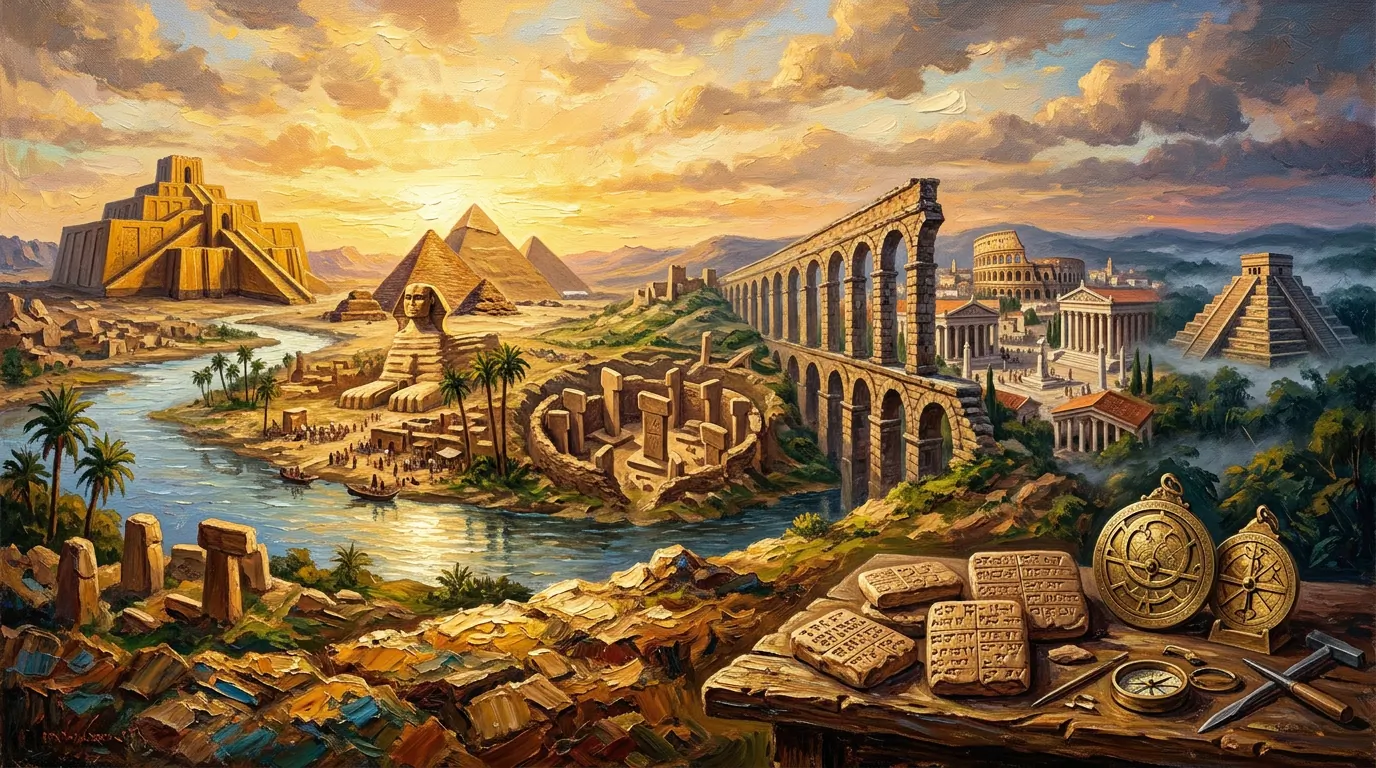
Human Civilization Trivia: Journey Through Lost Empires
Forget memorizing royal dynasties—explore 40 wild stories behind Sumerian beer wages, rooftop-door cities, jade-inlaid Maya teeth, and how humanity built civilization.
Most civilization quizzes put you to sleep asking which river flows through Egypt. The real story of how humans went from nomadic hunter-gatherers to builders of megacities is infinitely wilder: prehistoric bands carving 16-ton limestone temples at Göbekli Tepe thousands of years before anyone invented farming or pottery, Sumerian temple workers getting paid their daily wages in clay bowls of barley beer, and an entire 9,000-year-old Anatolian town built without a single street or front door.
From Mohenjo-daro's 4,500-year-old brick flush toilets and Roman seawater concrete that literally heals its own cracks to Cahokia outpopulating medieval London and Maya dentists drilling jade gems into living teeth, test your knowledge with 40 short, punchy, and verified Human Civilization Trivia Questions & Answers below!
1.What did ancient Mesopotamian pyramid and temple builders receive as their daily wages?
Show Answer & Explanation
Correct Answer: B. Clay ration bowls of beer
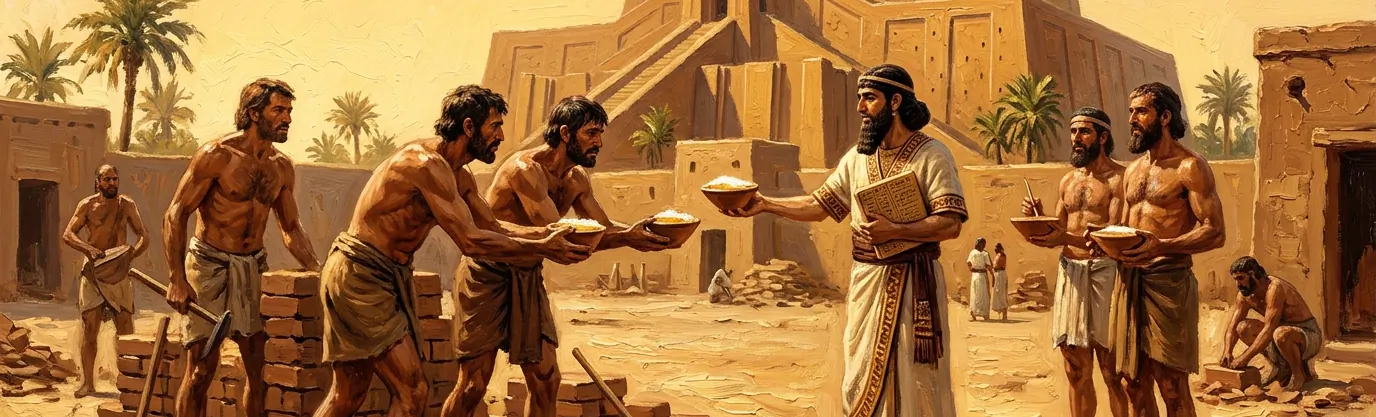
Explanation: More than five thousand years ago in the Sumerian city-states of Uruk and Ur, money as we know it did not exist yet—so temple administrators paid thousands of construction workers, canal diggers, and scribes directly in bevel-rimmed clay bowls filled with thick, nutritious barley beer!
One of the oldest surviving wage receipts in human history—a 5,000-year-old cuneiform clay tablet from Uruk now displayed in the British Museum—shows a human head eating from a ration bowl alongside a conical vessel symbolizing a daily beer allotment (about two pints a day for laborers, and up to five quarts for senior officials).
Because river water in crowded early Mesopotamian cities was frequently contaminated by human and livestock waste, low-alcohol fermented barley beer boiled during brewing was not only a calorie-packed liquid bread, it was also far safer to drink than raw canal water!
2.What shocked archaeologists about Turkey's 11,600-year-old Göbekli Tepe stone pillars?
Show Answer & Explanation
Correct Answer: D. Hunter-gatherers built them before farming
Explanation: For over a century, historians taught a simple rule for the birth of human civilization: first humans invented farming, then settled down in permanent villages, and only later had enough surplus food to build monumental stone temples.
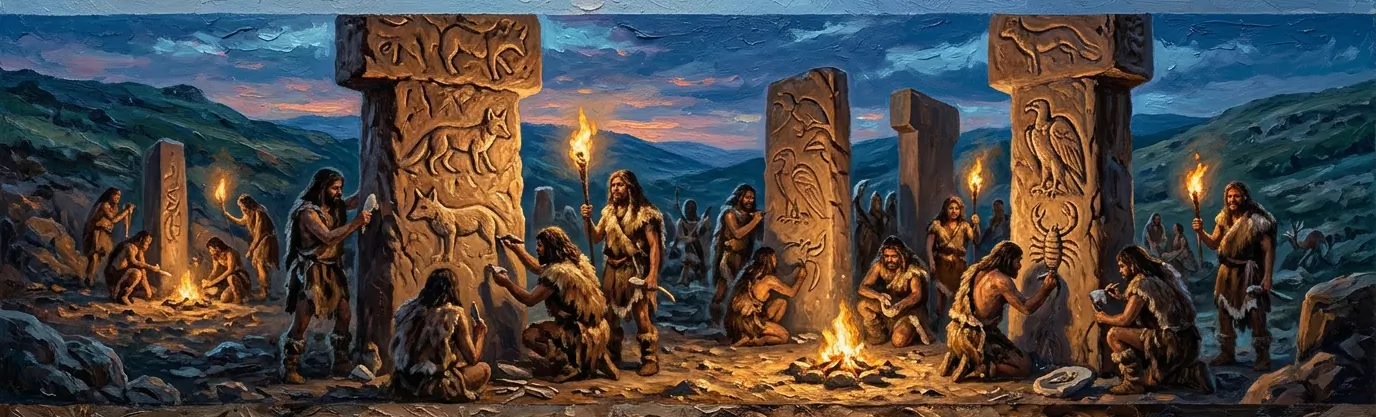
Then in 1994, German archaeologist Klaus Schmidt began excavating Göbekli Tepe in southeastern Turkey and overturned the textbook timeline overnight. Radiocarbon dating proved its concentric rings of 18-foot-tall, 16-ton T-shaped limestone pillars—carved with striking reliefs of foxes, vultures, scorpions, and wild boars—were erected around 9600 BCE, more than 6,500 years before Stonehenge!
Even more astonishing, no domesticated grain seeds, pottery shards, or metal tools existed at the site: nomadic Stone Age hunter-gatherers chipped the megaliths out of bedrock using only flint stones, proving that the urge to gather for shared sacred monuments actually came before—and likely sparked—the invention of agriculture!
3.Which ancient civilization built brick flush toilets connected to covered street sewers?
Show Answer & Explanation
Correct Answer: A. The Indus Valley Civilization
Explanation: While most Bronze Age rulers spent their wealth building colossal royal tombs and palaces, the Indus Valley (Harappan) Civilization of modern-day Pakistan and northwestern India obsessed over urban public hygiene and egalitarian city planning.
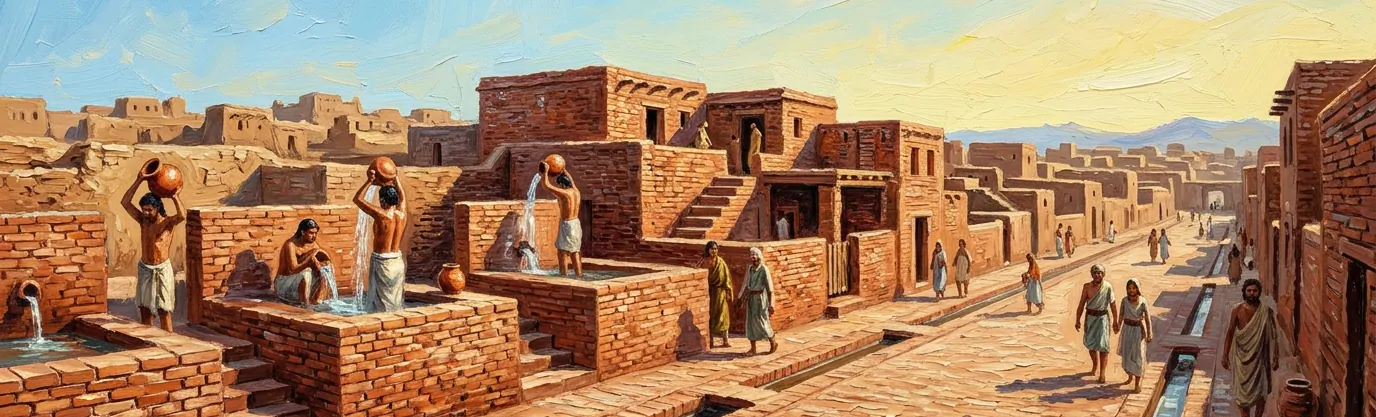
By 2500 BCE in metropolises like Mohenjo-daro and Harappa, nearly every single two-story baked-brick home—big or small—boasted its own private indoor bathing platform with a waterproofed brick floor and a sit-down brick latrine flushed with pitchers of water!
Wastewater flowed through tapered terracotta pipes built into the house walls directly into covered brick-lined street sewers equipped with removable stone manhole covers for municipal cleaning crews—a level of city-wide sanitation Europe would not match again for more than three thousand years!
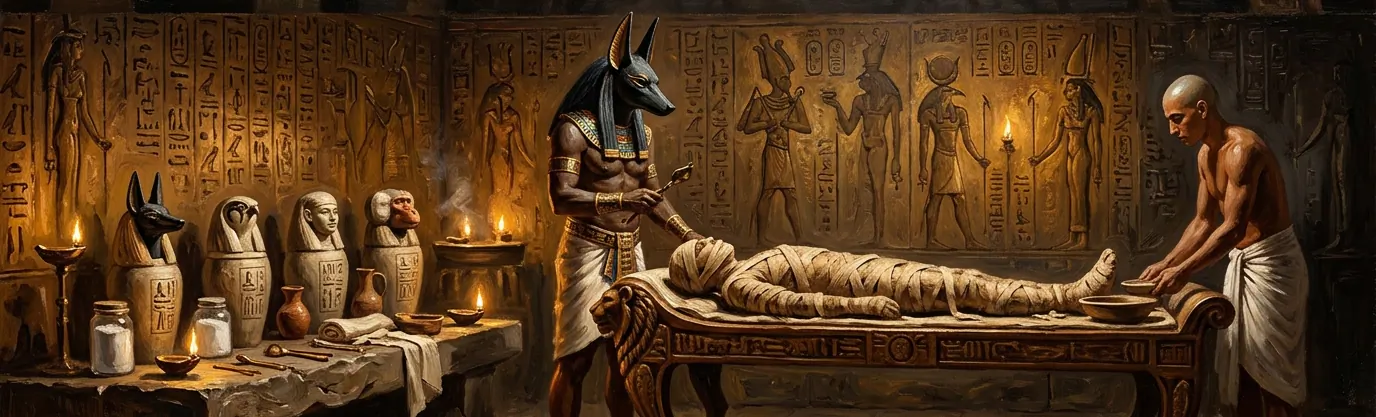
4.Which organ did ancient Egyptian embalmers throw away while leaving the heart inside?
Show Answer & Explanation
Correct Answer: C. The brain
Explanation: When ancient Egyptian priests prepared a pharaoh or noble for eternity, they carefully removed the stomach, intestines, lungs, and liver—drying them in natron salt and sealing them inside four sacred canopic jars guarded by the Four Sons of Horus.
The brain, however, received zero respect! Egyptian physicians believed the brain was merely a useless radiator that produced nasal mucus, whereas the heart (ib) held a person's intelligence, memories, emotions, and moral character—and had to remain inside the chest to be weighed against the feather of Ma'at in the afterlife.
Using a long, hooked bronze rod inserted right up through the nostril, embalmers punctured the ethmoid bone, whisked the brain tissue until it liquefied, drained it out of the nose, and threw it away before pouring warm pine resin inside the skull!
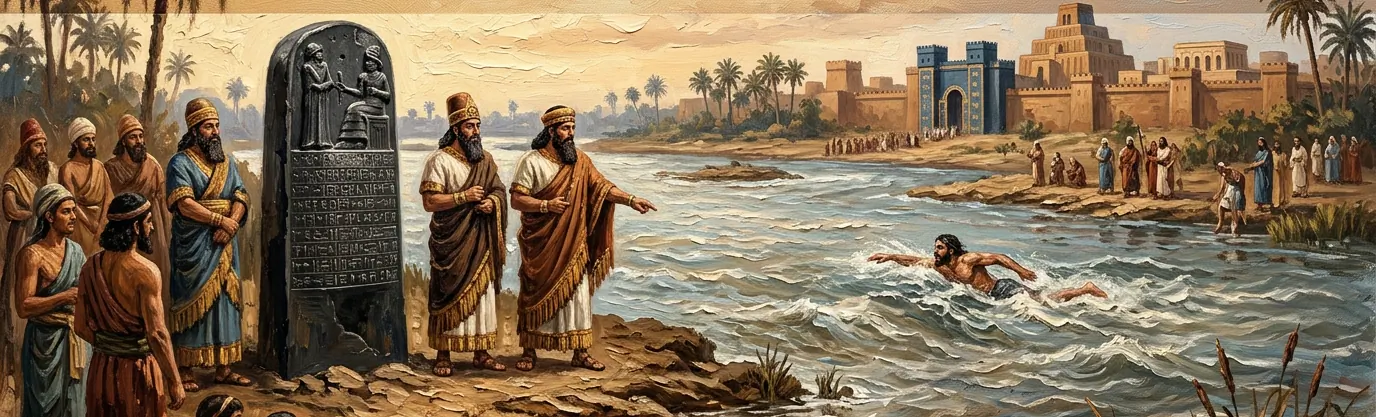
5.How did Babylon's Code of Hammurabi settle major accusations without any witnesses?
Show Answer & Explanation
Correct Answer: A. Throwing the accused into rivers
Explanation: Carved onto a seven-foot-tall gleaming black basalt stele around 1750 BCE, Babylonian King Hammurabi's 282 laws are famous for introducing "an eye for an eye, a tooth for a tooth" alongside surprisingly modern rules like minimum wages and a presumption of innocence until proven guilty.
When someone was accused of sorcery or adultery without hard evidence or eyewitnesses, however, Law #2 prescribed the "Ordeal by River": the accused citizen had to leap straight into the swirling waters of the Euphrates River so the river god Ea could render a verdict!
If the accused sank and drowned, their guilt was considered proven and the accuser inherited their house; if the accused managed to float or swim safely back to the riverbank, the river god had declared them innocent—and the false accuser was immediately put to death and their estate handed over to the survivor!
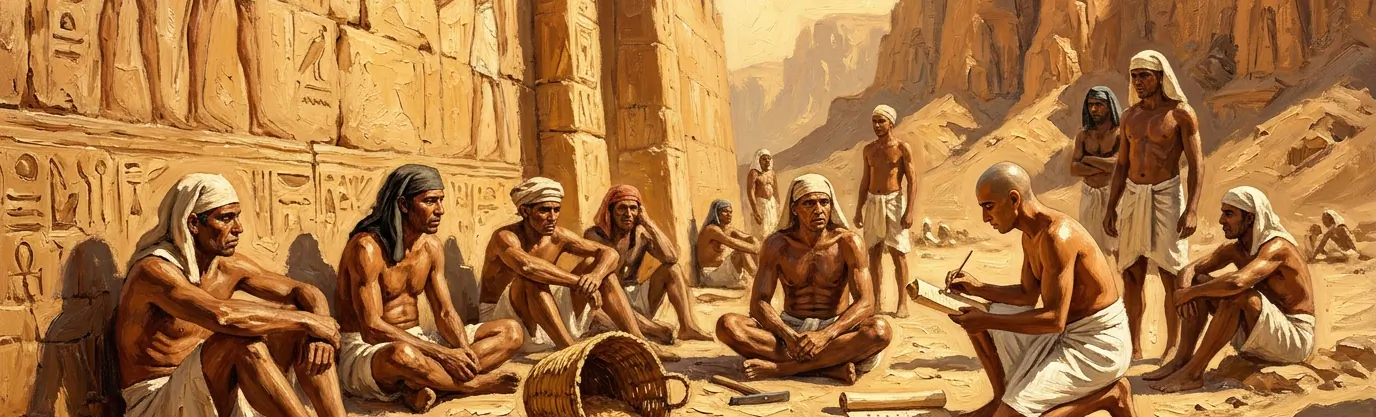
6.Why did Pharaoh Ramesses III's royal tomb builders stage history's first strike?
Show Answer & Explanation
Correct Answer: D. Their grain rations arrived late
Explanation: Contrary to Hollywood epics showing whipped slaves dragging stones across the desert, Egypt's royal tombs and monuments were built by an elite, highly literate community of state-paid master stonecutters, painters, and carpenters living in the walled village of Deir el-Medina.
In 1159 BCE, during the twenty-ninth year of Pharaoh Ramesses III's reign, the royal granaries failed to deliver the workers' monthly wages of emmer wheat (for bread), barley (for beer), and skin-moisturizing oil ointments on time for eighteen straight days.
As recorded by scribe Amennakht on the surviving Turin Strike Papyrus, the artisans laid down their bronze chisels, marched to the mortuary temples of the Valley of the Kings, and staged history's first recorded sit-in labor strike—chanting "We are hungry! We have no clothes, we have no ointment!" until the vizier delivered their back pay in full!
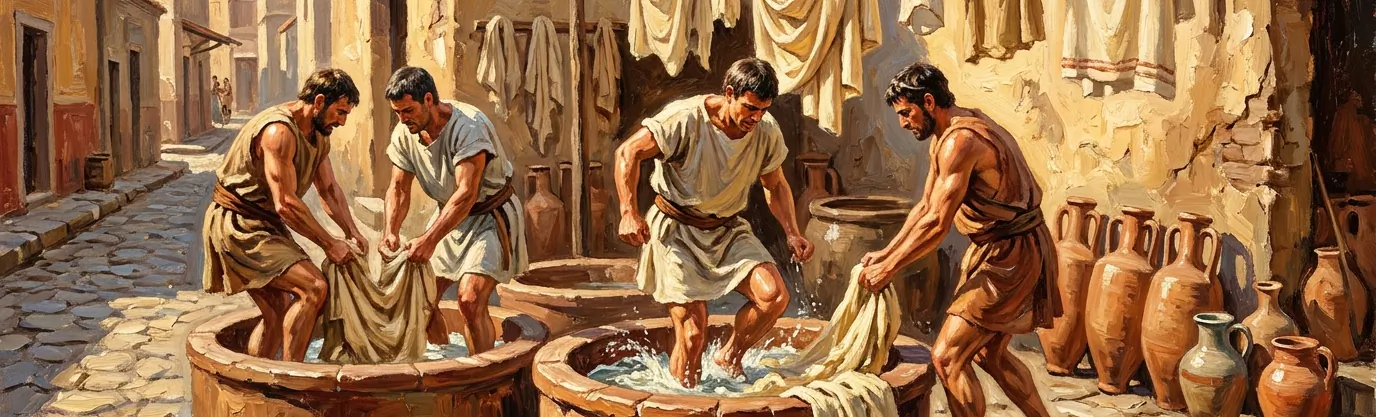
7.What smelly liquid did ancient Roman fullers collect from street pots to bleach togas?
Show Answer & Explanation
Correct Answer: B. Fermented human urine
Explanation: Keeping a heavy white wool Roman toga spotless without modern soap or chlorine bleach was big business in ancient Rome, handled by professional laundrymen called fullones (fullers) working in pungent workshops known as fullonicae.
Because stale human urine breaks down into natural ammonia—a powerful grease-cutting detergent and fabric brightener—fullers placed large terracotta pots on busy Roman street corners inviting passersby to relieve themselves, then hauled the fermented liquid back to their shops and stomped dirty togas barefoot inside sunken vats of urine and fuller's earth clay!
The trade was so lucrative that in 70 CE, Roman Emperor Vespasian slapped an imperial tax on urine collection from public urinals; when his son Titus complained that taxing pee was disgusting, Vespasian held a gold coin under his nose and uttered the immortal Latin proverb Pecunia non olet—"Money does not stink!"
8.How heavy were the giant basalt portrait heads carved by Mexico's ancient Olmecs?
Show Answer & Explanation
Correct Answer: C. Up to forty tons
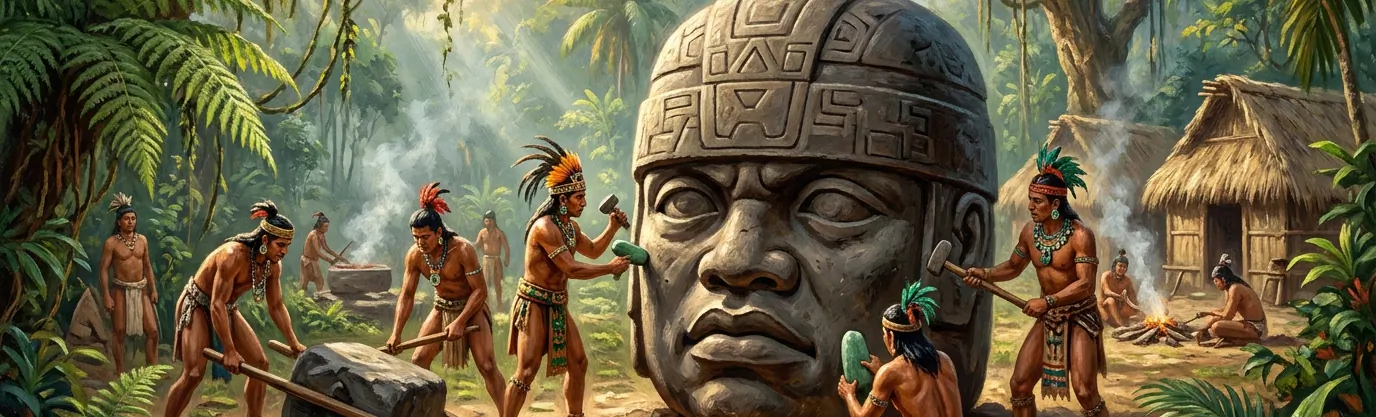
Explanation: Flourishing along Mexico's tropical Gulf Coast between 1500 and 400 BCE, the Olmec civilization—the "mother culture" of Mesoamerica that pioneered rubber balls, stepped pyramids, and the Long Count calendar—left behind seventeen colossal stone portrait heads of their rulers wearing protective ballgame helmets.
Each scowling head stands up to eleven feet tall and weighs between six and forty tons (the heaviest, Monument 1 at Cobata, tips the scales at roughly 80,000 pounds!), all chiseled from single volcanic basalt boulders using only hand-held stone hammerstones because the Olmecs had no metal tools.
Even more mind-boggling, the volcanic stone quarries in the Tuxtla Mountains lay more than fifty miles away across swamps, rivers, and jungle hills—meaning thousands of Olmec workers dragged forty-ton boulders on wooden sledges and river rafts without wheels or draft animals!
9.How did residents of Neolithic Çatalhöyük enter their mud-brick homes 9,000 years ago?
Show Answer & Explanation
Correct Answer: A. Down wooden ladders through roofs
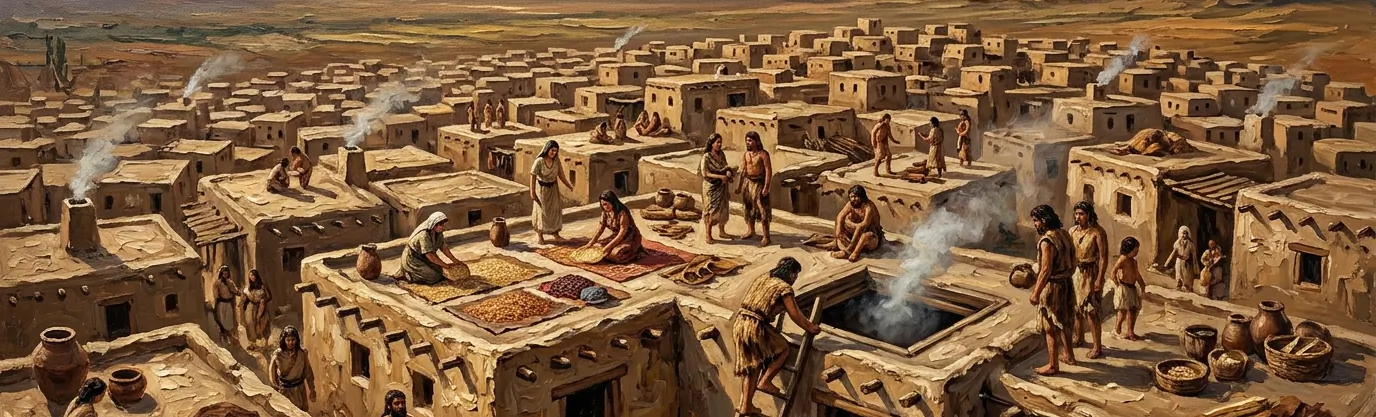
Explanation: Built around 7100 BCE on the Konya Plain of central Turkey, the Neolithic proto-city of Çatalhöyük housed up to 8,000 people at a time when nearly the rest of humanity lived in tiny wandering bands—yet the town did not have a single street, alleyway, or front door!
Instead, hundreds of rectangular mud-brick houses were built jammed directly against one another wall-to-wall like cells in a giant honeycomb, creating an unbroken outer wall that kept out wild predators, floodwaters, and raiders.
All daily traffic, socializing, and work happened Up on top of the flat contiguous rooftops! To go inside your house, you climbed down a steep wooden ladder through a square hole in the ceiling that doubled as the chimney for the indoor cooking hearth—and when family members died, they were buried directly beneath the plaster floor right under the family's beds!
10.What did ancient Athenians scratch onto broken pottery shards named 'ostraka' each year?
Show Answer & Explanation
Correct Answer: D. Politicians to banish ten years
Explanation: After overthrowing their last tyrant in 510 BCE, the citizens of democratic Athens invented a brilliant constitutional safety valve to stop any charismatic general or billionaire aristocrat from growing too powerful and making himself dictator.
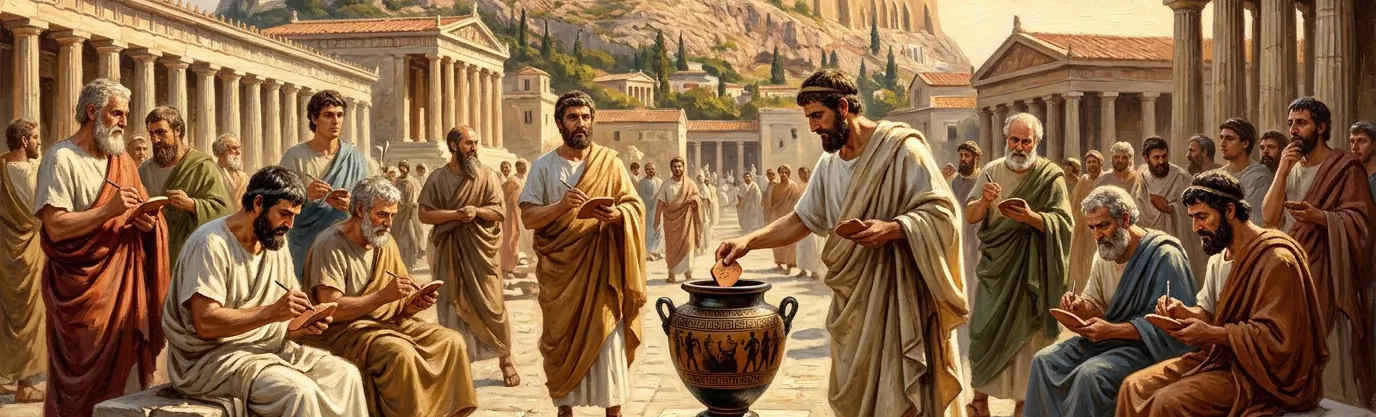
Once a year, the Athenian Assembly voted on whether to hold an ostrakophoria. If they voted yes, thousands of citizens gathered in the Agora and scratched the name of whichever politician they wanted out of town onto a broken piece of cheap terracotta pottery called an ostrakon—the direct origin of our English word "ostracize"!
Provided at least 6,000 potsherds were cast, the "winner" with the most votes had ten days to pack his bags and leave Athens for ten years! His property and citizenship remained untouched while he was gone, and archaeologists have even uncovered cache pits of 190 pre-inscribed ostraka written in the exact same handwriting against the general Themistocles—evidence of ancient campaign ballot-stuffing!
11.What was completely missing from Peru's 5,000-year-old pyramid city of Caral?
Show Answer & Explanation
Correct Answer: B. Weapons, battlements, and war
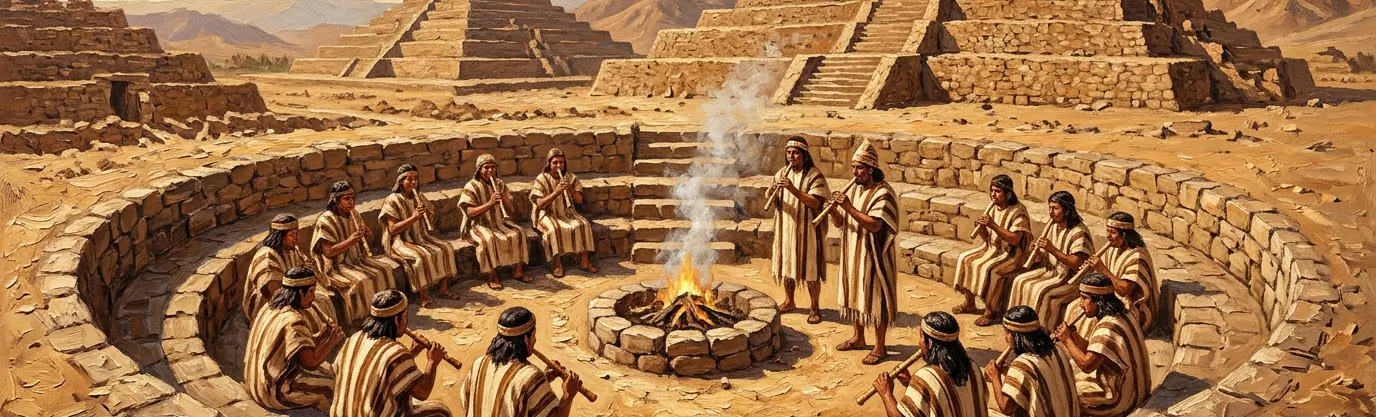
Explanation: Rising from Peru's arid Supe Valley around 2600 BCE—at the exact same time Pharaoh Khufu was building the Great Pyramid of Giza in Egypt—the Sacred City of Caral is the oldest known urban civilization in the Americas, spanning over 150 acres of monumental terraced pyramids and sunken circular plazas.
When Peruvian archaeologist Ruth Shady excavated Caral and its neighboring settlements across the valley, she uncovered something that defied almost every ancient Old World empire: not a single defensive wall, battlement, spear point, club, or war-damaged skeleton existed anywhere across a thousand years of occupation!
Instead of warfare, Caral's society thrived on peaceful trade and ritual music—coastal fishermen traded dried anchovies and shellfish for the inland valley's cotton fishing nets and gourds, while excavations inside Caral's main amphitheater uncovered thirty-two intricately carved condor- and pelican-bone flutes and thirty-eight cornets made from deer and llama bones!
12.Why has ancient Roman harbor concrete grown stronger underwater for two thousand years?
Show Answer & Explanation
Correct Answer: C. Seawater reacts with volcanic ash
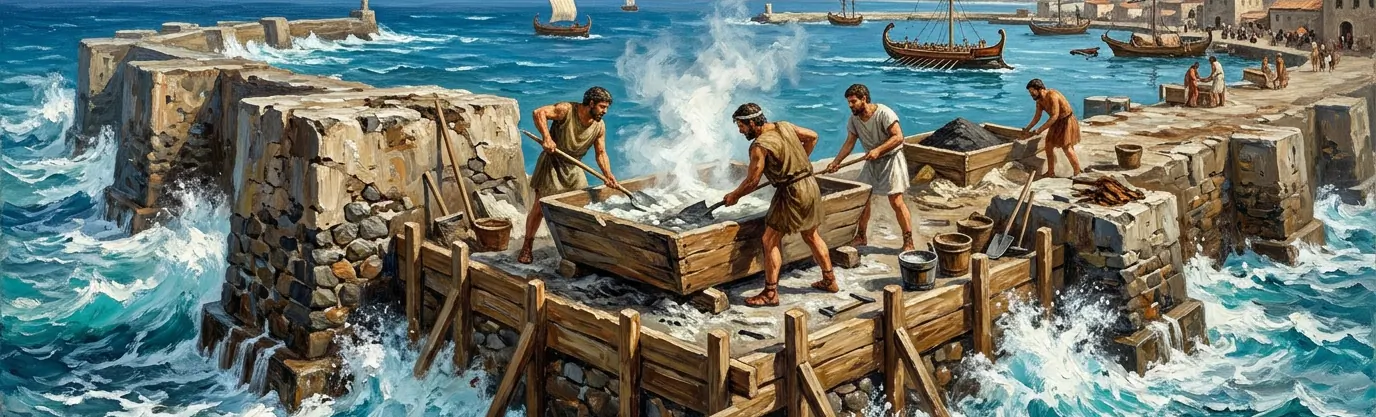
Explanation: Modern steel-reinforced Portland cement piers start crumbling after fifty years in saltwater as seawater corrodes the internal rebar—yet ancient Roman harbor breakwaters built two thousand years ago along the Italian coast are actually harder today than the day Roman engineers poured them!
Using X-ray microdiffraction at Lawrence Berkeley National Laboratory and MIT, scientists discovered the secret behind Roman opus caementicium: Roman builders mixed volcanic ash from Pozzuoli (near Mount Vesuvius) with quicklime at scorching temperatures, leaving tiny reactive white "lime clasts" trapped inside the mortar.
Whenever waves crack the concrete and seawater seeps inside, the saltwater dissolves the volcanic ash and lime clasts to grow interlocking plate-like crystals of a rare mineral called aluminous tobermorite—literally sealing the cracks and reinforcing the concrete from within!
13.Why did seafaring Phoenician traders invent a twenty-two-letter alphabet around 1050 BCE?
Show Answer & Explanation
Correct Answer: A. Fast bookkeeping for merchant sailors
Explanation: For the first two thousand years of writing, literacy belonged to a tiny caste of palace scribes because Mesopotamian cuneiform and Egyptian hieroglyphs required memorizing hundreds of complex word-signs and syllable symbols over a decade of schooling.
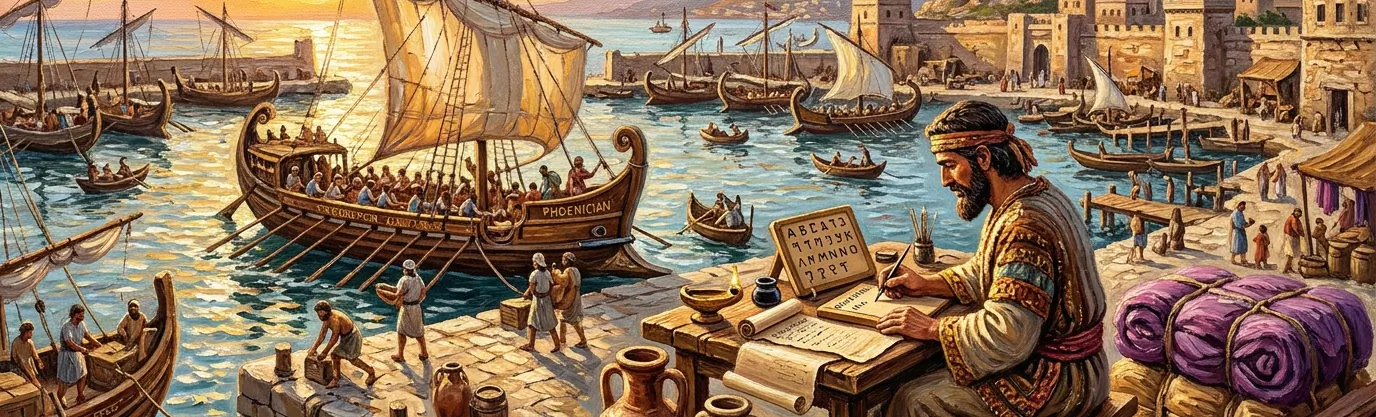
Sailing out of busy Lebanese port cities like Byblos, Tyre, and Sidon around 1050 BCE, Phoenician sea merchants needed a fast, practical way to jot down bills of lading, wine amphora tallies, and contracts with foreign buyers across the Mediterranean.
Building on earlier Proto-Sinaitic scripts, the Phoenicians streamlined writing down to just twenty-two simple consonant letters where each symbol stood for a single spoken sound—so easy to learn in days that the Greeks soon adopted it (adding vowels), passed it to the Etruscans and Romans, and gave birth to almost every alphabet used on Earth today!
14.What did wealthy ancient Maya dentists inlay directly into nobles' living front teeth?
Show Answer & Explanation
Correct Answer: B. Polished jade and turquoise gems
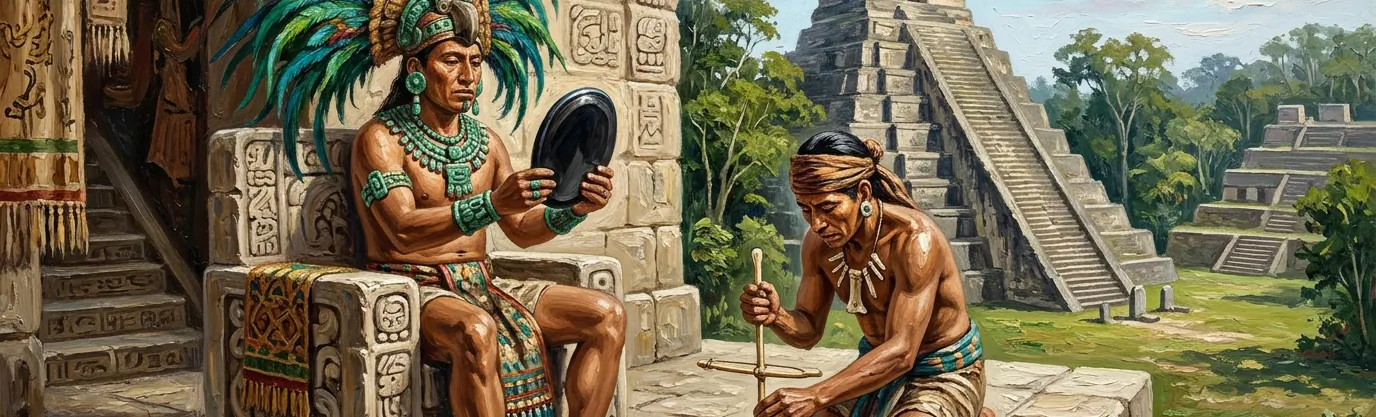
Explanation: Long before modern cosmetic dentistry or twenty-first-century tooth "grillz," Classic Maya men and women across Mexico and Guatemala prized a glittering smile studded with circular cabochons of emerald-green jadeite, turquoise, iron pyrite, and red hematite!
Remarkably, this was performed on living adults rather than after death: skilled Maya dental artisans spun a hollow tube of bone or copper between their palms with powdered quartz sand and water as an abrasive, drilling perfectly round millimeter-deep cavities into the enamel of the front incisors without cracking the tooth or hitting the nerve pulp!
Even more impressive, chemical analysis published in the Journal of Archaeological Science revealed that the pine-tar and plant-resin cement used to glue the gems in place contained natural antibacterial and anti-inflammatory compounds that prevented tooth decay—keeping the jade inlays locked tight for the patient's entire life!
15.How did ancient Persians irrigate bone-dry deserts without losing water to evaporation?
Show Answer & Explanation
Correct Answer: D. Gravity-fed underground mountain tunnels
Explanation: The Iranian Plateau is one of the hottest, driest landscapes on Earth, without a single great river like the Nile or Euphrates—yet by the first millennium BCE, the Persian Empire supported flourishing desert cities and lush walled paradise gardens (*pairidaeza*, the origin of our word "paradise").
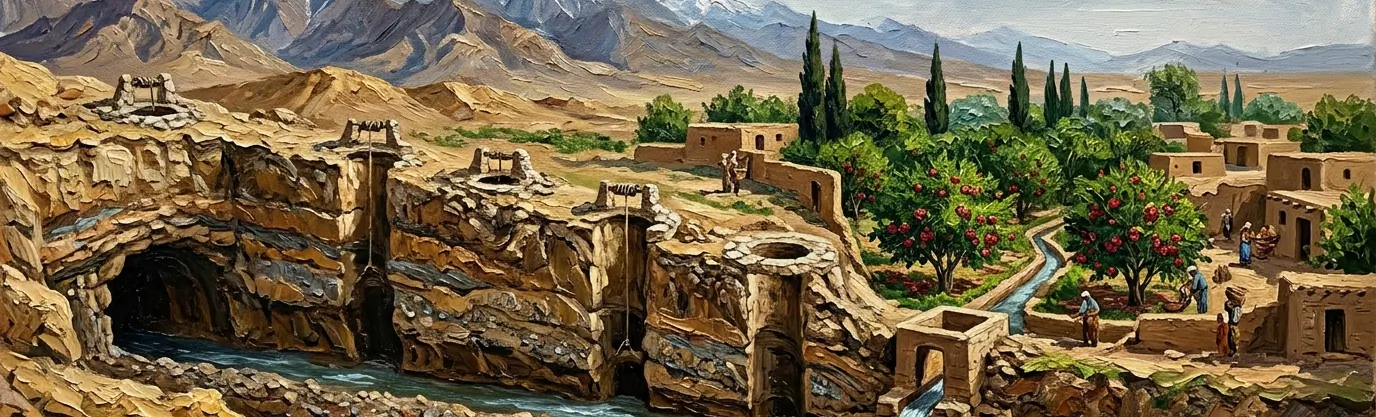
Their secret was the *qanat* (or *karez*): an ingenious hydraulic engineering marvel created by digging a "mother well" deep into the water table at the base of snow-capped mountains, then excavating a gently sloping subterranean tunnel for ten to forty miles underneath the desert floor!
Connected to the surface every fifty yards by vertical ventilation and maintenance shafts (which look from the air like lines of giant ant hills), gravity carried ice-cold mountain groundwater directly into desert towns and fields with zero pumping and almost zero loss to desert sun evaporation—and thousands of ancient Persian qanats still flow across Iran today!
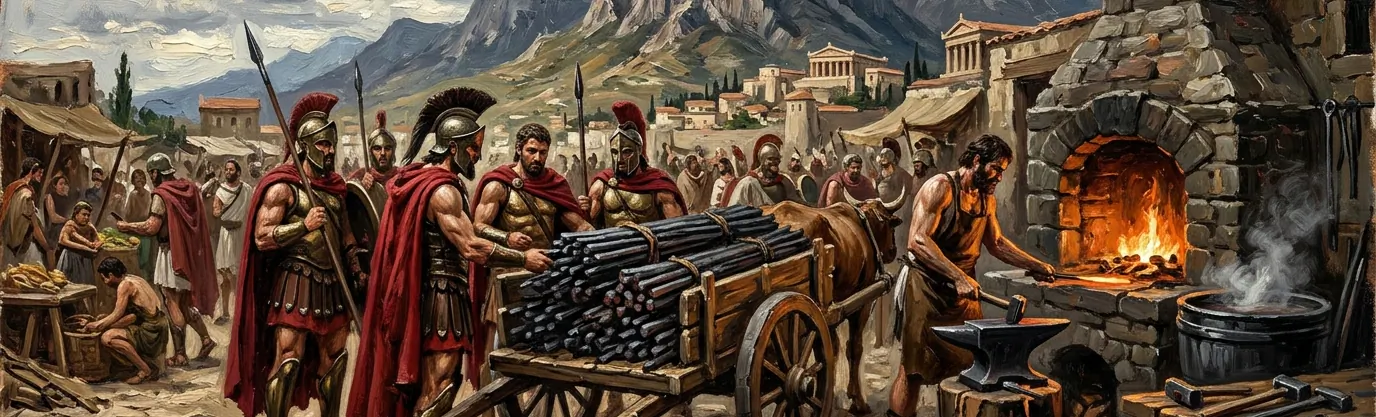
16.Why did ancient Sparta use heavy, vinegar-quenched iron rods as its official money?
Show Answer & Explanation
Correct Answer: C. To stop bribery and hoarding
Explanation: While neighboring Greek city-states like Athens and Corinth minted gleaming silver owls and winged horses that fueled international trade, ancient Sparta deliberately banned all gold and silver coinage among its citizens under the reforms attributed to its legendary lawgiver Lycurgus.
In place of coins, Spartans were forced to use *pelanor*—clumsy, heavy iron spit-bars that were pulled glowing-hot from the blacksmith's forge and quenched in a vat of acid vinegar to make the metal brittle and completely useless for reforging into tools or swords!
As the Greek biographer Plutarch delightedly noted, an amount of Spartan iron money worth just ten minas (a modest household sum) required a two-ox wagon to haul and an entire storeroom to lock away—instantly wiping out purse-snatching, secret political bribery, and luxury hoarding in Sparta!
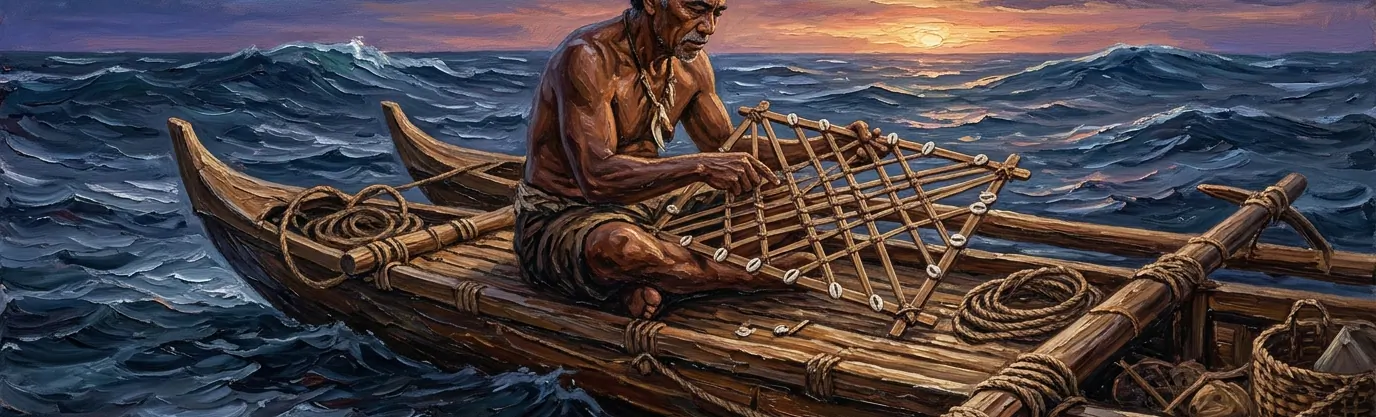
17.What did Marshall Islands navigators map using lashed coconut-frond sticks and cowrie shells?
Show Answer & Explanation
Correct Answer: A. Refracted ocean wave swell patterns
Explanation: Centuries before European explorers dared sail out of sight of land with magnetic compasses and sextants, Micronesian and Polynesian wayfinders colonized thousands of tiny Pacific islands across an ocean covering one-third of the globe using only wooden outrigger canoes.
In the Marshall Islands, master navigators passed down intricate latticework grids woven from curved coconut-palm midribs and dotted with tiny white cowrie shells—known as *mattang*, *meddo*, and *rebbelib* stick charts.
Whereas cowrie shells marked the positions of low-lying coral atolls, the curved wooden ribs did not show currents or wind directions—they mapped how distant islands blocked, bent, and refracted deep-ocean wave swells! Navigators memorized the stick charts on land (never bringing them to sea) and lay flat on the bottom of their canoe hulls with eyes closed to feel the crossing swell patterns through the wood!
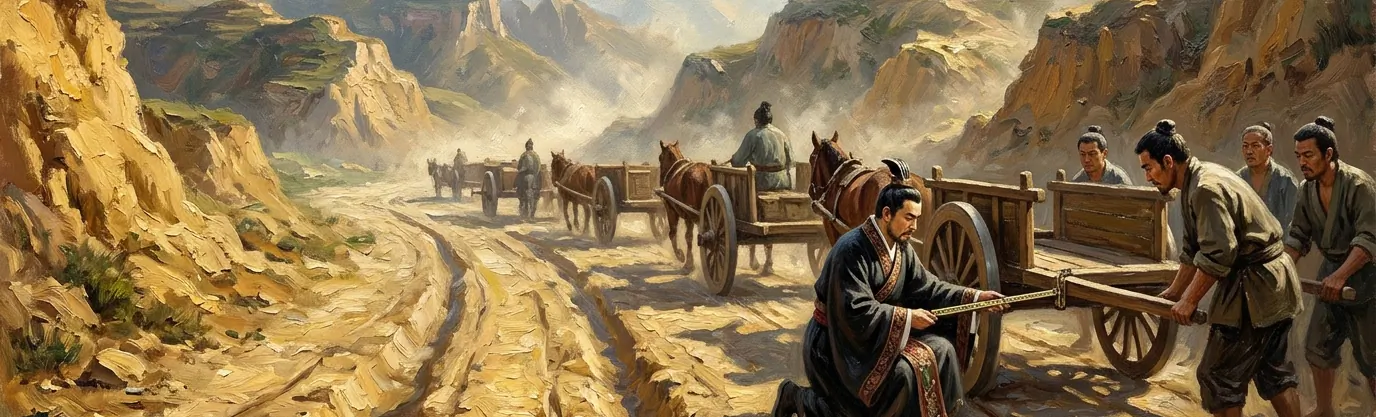
18.Why did Emperor Qin Shi Huang standardize cart axle widths across China?
Show Answer & Explanation
Correct Answer: B. So wheels fit road ruts
Explanation: When Qin Shi Huang conquered China's six rival Warring States in 221 BCE to become the First Emperor, he immediately standardized Chinese writing characters, weights, measures, bronze coin shapes—and, crucially, the exact length of every wooden cart and chariot axle in the empire!
That might sound like obsessive micromanagement, but northern China's roads were built over soft, powdery yellow loess soil (*huangtu*). Heavy wooden cart wheels quickly carved deep, hardened canyon-like ruts into every highway.
During the Warring States era, each kingdom deliberately used a different axle width so invading armies' carts wouldn't fit their road ruts; if a merchant crossed a border with a wider or narrower axle, one wheel rode inside the rut while the other tilted precariously on the ridge until the axle snapped! Standardizing every axle to six Qin feet instantly unified trade across 4,000 miles of imperial highways!
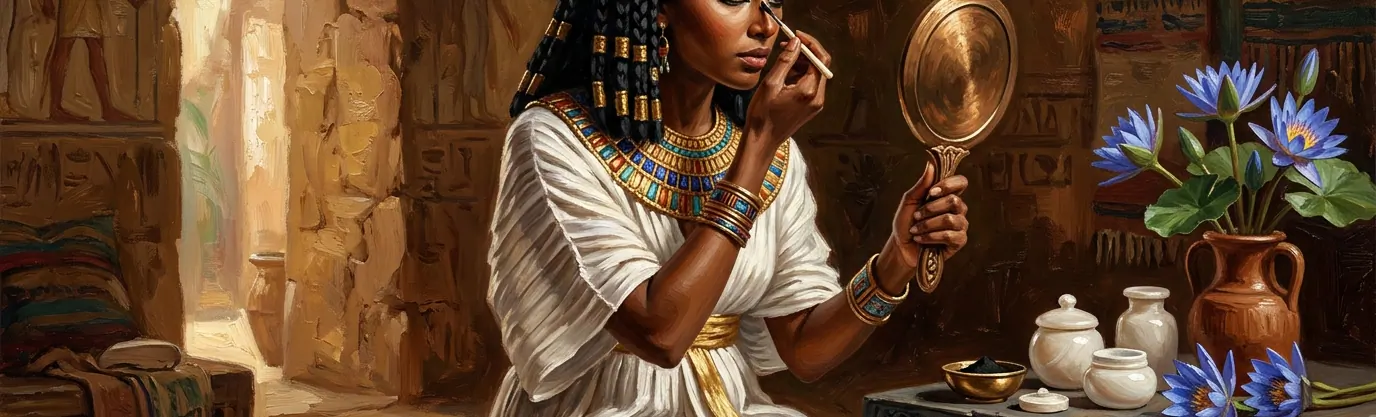
19.Besides style and sun glare, how did thick black kohl eyeliner help ancient Egyptians?
Show Answer & Explanation
Correct Answer: D. It killed eye-infecting bacteria
Explanation: Every ancient Egyptian portrait—from Queen Nefertiti and King Tutankhamun to humble farmers—shows men, women, and children wearing bold black *kohl* eyeliner painted around their eyes using recipes ground from dark galena (lead sulfide) and white lead carbonate minerals that took a month to synthesize.
For decades, modern toxicologists assumed ancient Egyptians were accidentally poisoning themselves with lead cosmetics—until a team of French chemists from the Louvre and CNRS tested genuine ancient Egyptian makeup pots from museum collections in 2010.
Publishing in Analytical Chemistry, they discovered that the ultra-tiny doses of synthetic lead salts (specifically laurionite and phosgenite) triggered skin cells around the eye to boost nitric oxide production by 240%—supercharging the immune system's macrophage cells to destroy bacteria flushed into eyes during the annual Nile floods!
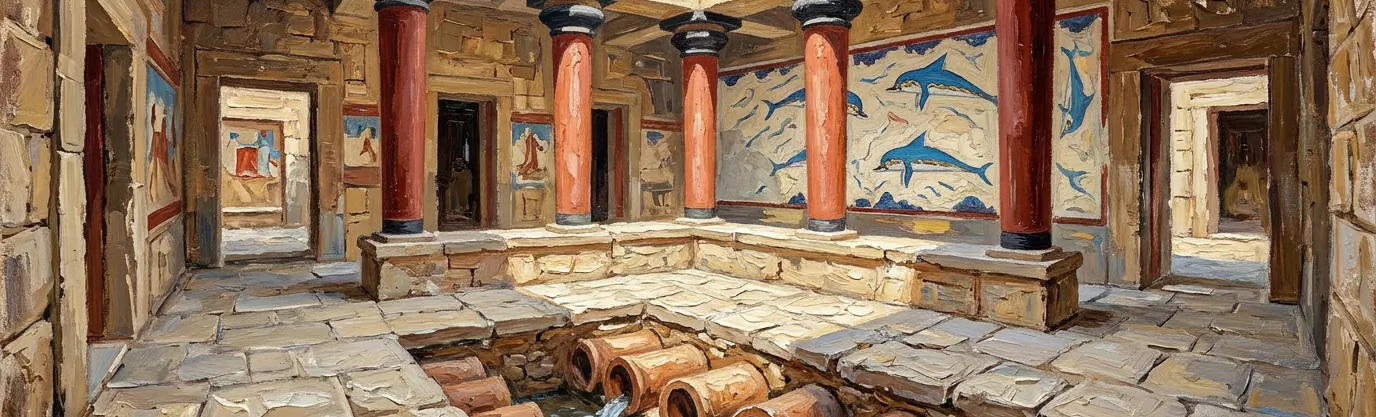
20.What surprisingly modern utility ran beneath Crete's Minoan Palace of Knossos around 1700 BCE?
Show Answer & Explanation
Correct Answer: A. Tapered terracotta pressure water pipes
Explanation: When British archaeologist Sir Arthur Evans excavated the Bronze Age Minoan Palace of Knossos on the island of Crete in 1900, Victorian engineers visiting the site could hardly believe the 3,700-year-old hydraulic network hidden beneath the palace courtyards.
Minoan engineers brought fresh mountain spring water from seven miles away using interlocking, conical terracotta pipe segments fitted with clay collars and cemented seals. Because each pipe segment tapered toward its nozzle, the narrowing bore created a Venturi jet effect that accelerated water speed and prevented silt from settling inside the pipes!
Even more remarkable, the palace featured separate storm-water stone drains with parabolic velocity-slowing curves to prevent flooding during Mediterranean cloudbursts, along with an upstairs "Queen's Megaron" restroom equipped with a wooden seat over a stone chute flushed by rainwater cisterns!
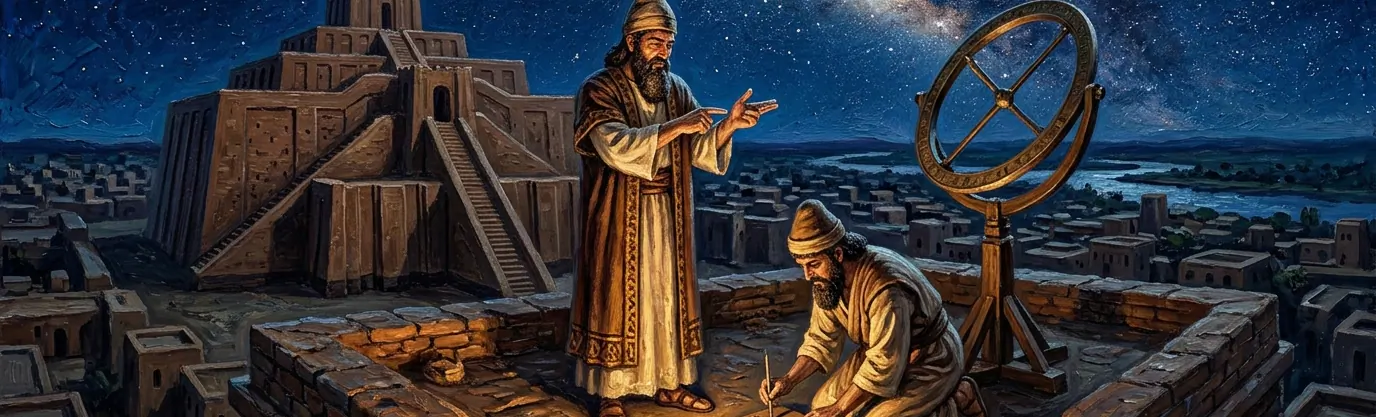
21.Why did ancient Babylonian mathematicians count in base-sixty instead of base-ten?
Show Answer & Explanation
Correct Answer: C. Sixty divides evenly twelve ways
Explanation: Every time you check your watch and see 60 seconds in a minute, 60 minutes in an hour, or measure 360 degrees in a circle, you are using a numeral system invented over four thousand years ago by Sumerian and Babylonian scribes in ancient Iraq!
While counting by tens is easy on ten fingers, 10 is a terrible number for splitting grain, land, or silver into fractions because 10 only divides evenly by 1, 2, 5, and 10 (try dividing 10 sacks of barley equally among three brothers!).
Sixty, by contrast, is a "superior highly composite number"—the smallest number divisible evenly by 1, 2, 3, 4, 5, 6, 10, 12, 15, 20, 30, and 60! Infact, Babylonians could count to 60 on their hands by using the thumb of one hand to tap the 12 finger bones of their four fingers, while holding up 1 to 5 fingers on the other hand ($12 imes 5 = 60$)!
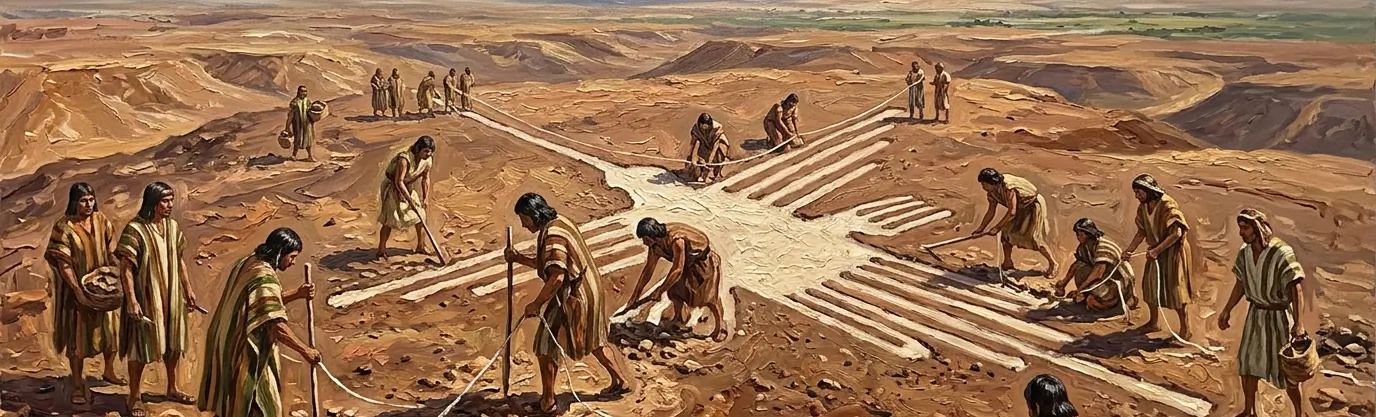
22.How did Peru's ancient Nazca people draw giant desert animal figures lasting 2,000 years?
Show Answer & Explanation
Correct Answer: B. Scraping rust-colored pebbles off white clay
Explanation: Stretching across 170 square miles of southern Peru's bone-dry Pampa Colorada ("Red Plain"), the Nazca Lines feature over 800 geometric runways and 70 giant zoomorphic geoglyphs—including a 300-foot hummingbird, a monkey with a spiral tail, a killer whale, and a spider—created between 500 BCE and 500 CE.
Despite wild twentieth-century pop-culture myths about alien landing strips, the Nazca people needed no flying machines or heavy machinery: they laid out scaled grid coordinates using simple wooden stakes and cotton surveying ropes!
To draw each glowing white line, workers simply scraped away the top four to six inches of dark, reddish-brown pebbles coated in desert iron-oxide ("desert varnish") to expose the bright, high-contrast yellowish-white lime clay underneath—where less than twenty minutes of rain per year and a warm air cushion kept the lines intact for two millennia!
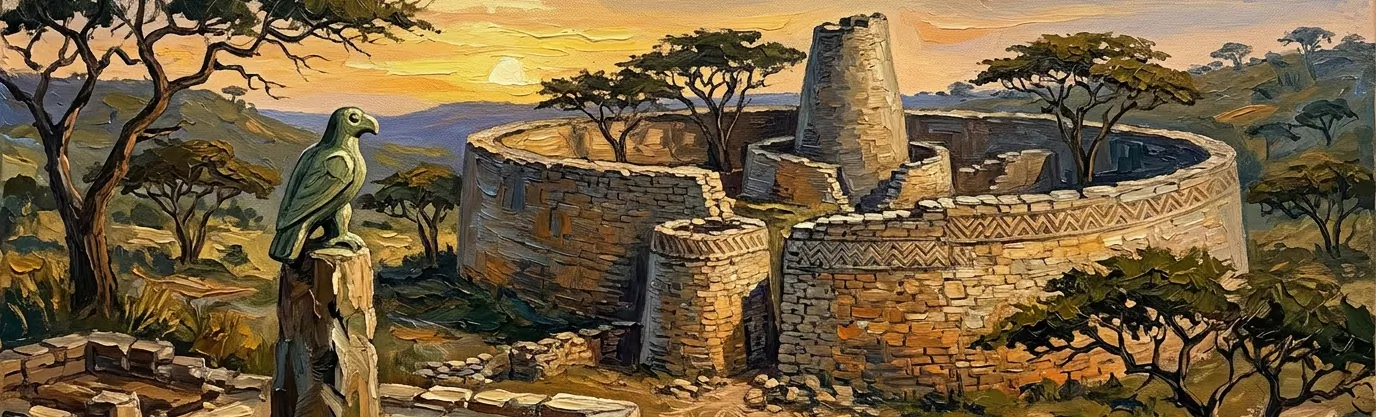
23.What held together the thirty-six-foot-tall granite walls of medieval Great Zimbabwe?
Show Answer & Explanation
Correct Answer: D. Nothing—pure dry-stone gravity
Explanation: Constructed between the eleventh and fifteenth centuries by the ancestors of the Shona people in southern Africa, the thriving trading capital of Great Zimbabwe ("houses of stone" in Shona, the namesake of modern Zimbabwe) housed up to 18,000 inhabitants and linked inland African goldfields to Indian Ocean ports Trading Chinese porcelain and Persian glass.
Its monumental centerpiece, the Great Enclosure, is surrounded by a curving outer wall standing 36 feet tall and 820 feet around, assembled from nearly one million uniform rectangular blocks of local granite—without a single drop of mortar!
To cleave granite boulders into brick-sized blocks without dynamite or power saws, Shona masons lit roaring hardwood fires along natural fracture seams in the granite hills and doused the red-hot rock with cold water, splitting clean slabs that were hand-dressed and stacked in curving chevron-patterned courses held firm by sheer gravity!
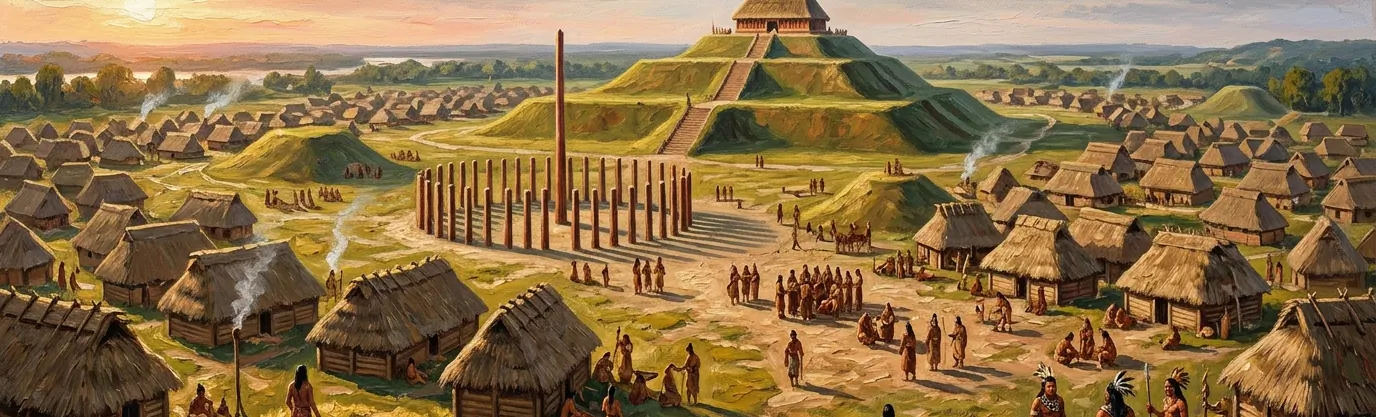
24.Which pre-Columbian earthen pyramid city near modern St. Louis outpopulated medieval London in 1150?
Show Answer & Explanation
Correct Answer: A. Cahokia
Explanation: Ask most people to name the largest city north of Mexico before Christopher Columbus arrived, and few realize that in 1150 CE, a bustling Mississippian metropolis of up to 20,000 people stood just across the Mississippi River from modern downtown St. Louis, Missouri—making it larger than contemporary London or Paris!
Known today as Cahokia, the six-square-mile city contained 120 ceremonial earthen mounds laid out around a forty-seven-acre leveled Grand Plaza, alongside solar calendar circles of red-cedar posts nicknamed "Woodhenge."
At its heart still rises Monks Mound—a four-terraced, 100-foot-tall earthen pyramid built entirely of 22 million hand-woven baskets of soil carried on workers' backs, whose fourteen-acre base footprint is actually larger than that of the Great Pyramid of Giza in Egypt!
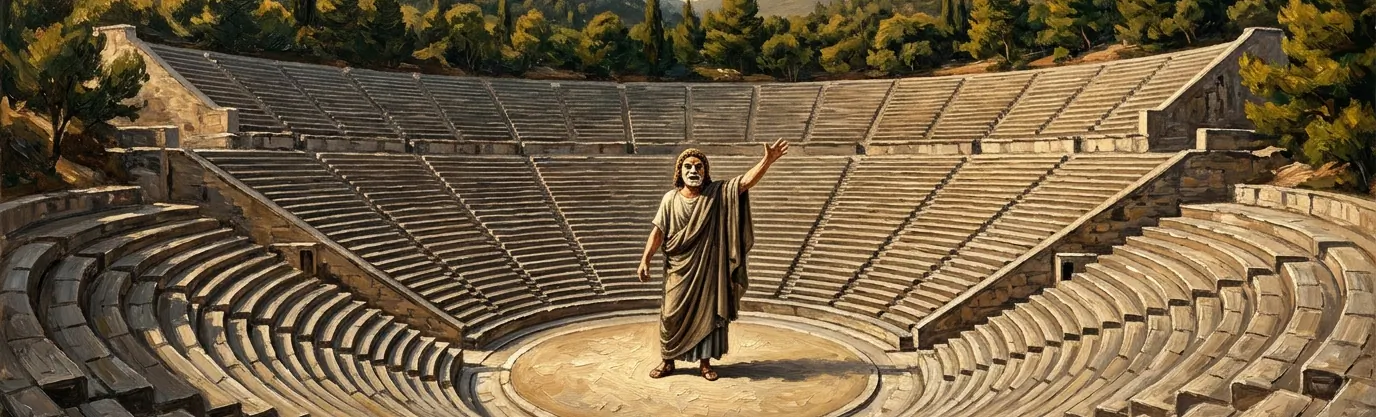
25.Why can whispers on Epidaurus's Greek theater stage reach the top row?
Show Answer & Explanation
Correct Answer: C. Corrugated seats filter background noise
Explanation: Designed in the fourth century BCE by the architect Polykleitos the Younger to hold 14,000 spectators across 55 semi-circular tiers, the Ancient Theater of Epidaurus in Greece has baffled visitors for centuries: an unamplified actor striking a match, tearing paper, or whispering on the circular orchestra floor can be heard crystal-clear in the very top row nearly 200 feet away!
Ancient Roman architect Vitruvius thought hidden bronze resonating vessels were tucked under the seats, while modern tour guides long blamed prevailing mountain breezes.
In 2007, acoustic engineers Nico Declercq and Cindy Dekeyser at the Georgia Institute of Technology solved the mystery: the periodic, corrugated rows of ribbed limestone benches act like an acoustic diffraction grating that suppresses low-frequency background noise below 500 Hz (wind rustle and crowd murmur) while reflecting high-frequency human speech vowels and consonants straight up to the audience!
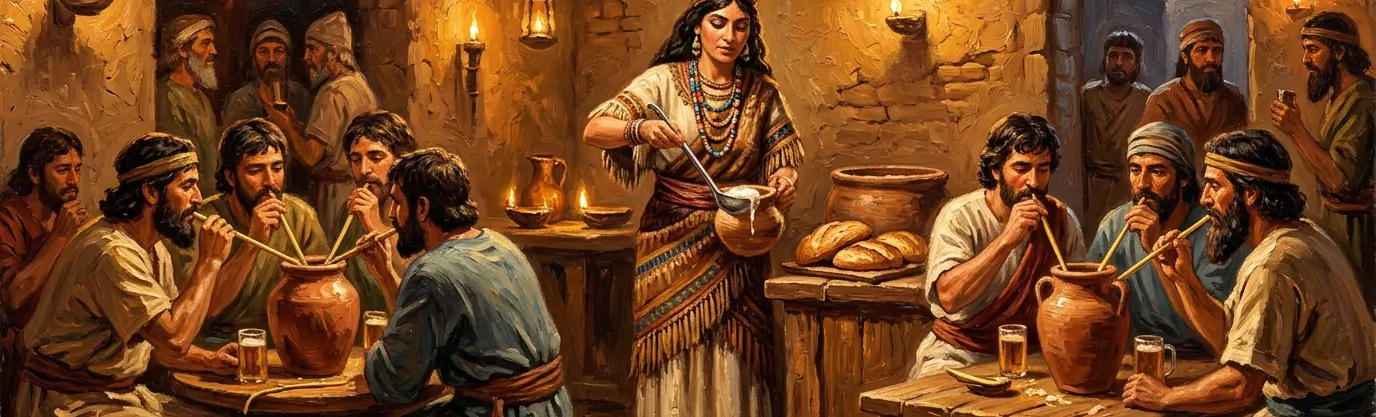
26.In ancient Babylon, who ran nearly all neighborhood taverns and brewed the beer?
Show Answer & Explanation
Correct Answer: B. Priestesses and independent women
Explanation: For the first two thousand years of Mesopotamian civilization, brewing beer and running the local tavern was almost exclusively a woman's profession, presided over by the Sumerian goddess of brewing, Ninkasi—whose 1800 BCE "Hymn to Ninkasi" is actually a rhyming step-by-step recipe for fermenting twice-baked barley bread (*bappir*) with dates and honey!
Known in Akkadian as a *sābītu*, the female Babylonian tavern keeper was a respected independent businesswoman who brewed unfiltered barley beer (drunk by groups of patrons through long hollow reed straws from a shared communal jar to filter out the floating grain husks) and extended credit to farmers until harvest time.
Four separate statutes in the Code of Hammurabi specifically regulated the *sābītu*—including Law #108, which decreed that any tavern woman caught shortchanging customers by using underweight stone weights for silver or serving less beer than the standard grain price should be bound and thrown into the river!

27.How did Andean civilizations preserve potatoes for up to ten years without refrigeration?
Show Answer & Explanation
Correct Answer: D. Freezing and trampling them dry
Explanation: Long before modern astronauts carried freeze-dried ice cream into orbit, the Tiwanaku and Inca civilizations of the high Andes mountains invented true atmospheric freeze-drying over a thousand years ago to create *chuño*—dehydrated potatoes that could sit in imperial storehouses (*qullqas*) for a full decade without spoiling!
Every June and July during the dry Andean winter at altitudes above 12,500 feet, farmers spread newly harvested frost-resistant bitter potatoes across straw beds on the ground, where nighttime temperatures plunged well below freezing and turned the water inside the tubers into ice crystals.
When the intense high-altitude tropical sun came out the next day, entire families—women, men, and children—walked barefoot across the thawing potatoes to squeeze out every drop of bitter water and slip off the skins; after five days of alternating night frosts and daytime sun-drying, the rock-hard, feather-light *chuño* kept Inca armies fed across 25,000 miles of mountain roads!
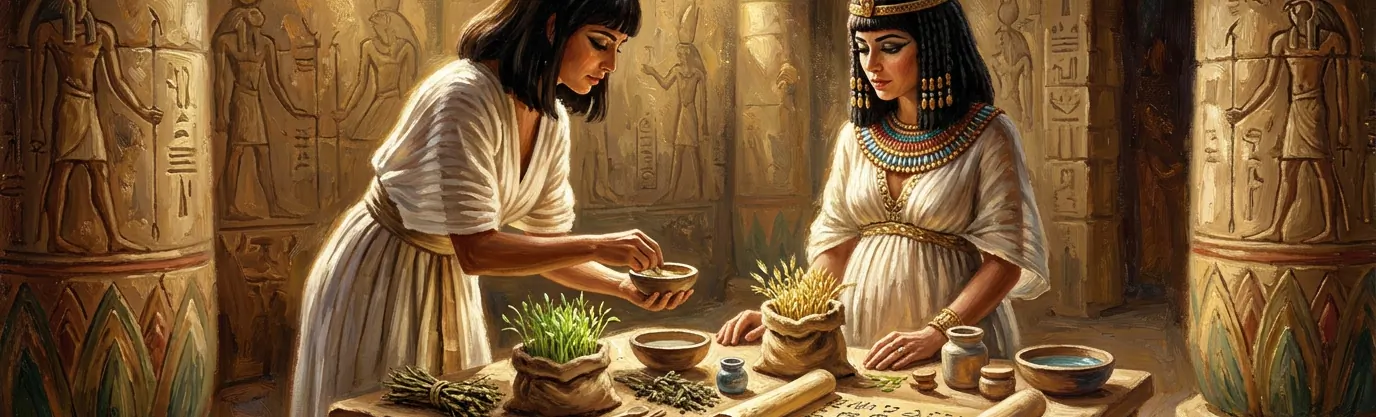
28.How did ancient Egyptian doctors test for pregnancy around 1350 BCE?
Show Answer & Explanation
Correct Answer: A. Watering barley and wheat bags
Explanation: Written on papyrus around 1350 BCE during the New Kingdom and preserved today in the Berlin State Museums, the Berlin Medical Papyrus (alongside the Carlsberg Papyrus) describes the world's oldest recorded home pregnancy test—using bags of grain!
The medical scroll instructed an Egyptian woman who suspected she might be pregnant to urinate daily onto two small cloth bags filled with dry barley and emmer wheat seeds mixed with dates and sand: "If they both sprout, she will give birth... if neither sprouts, she will not give birth."
Far from mere superstition, researchers at the National Institutes of Health tested the ancient Egyptian grain assay in 1963 and discovered that the urine of pregnant women successfully triggered seed germination roughly 70% of the time—while urine from non-pregnant women and men never did—likely because elevated estrogen levels in pregnancy urine stimulate seed growth!
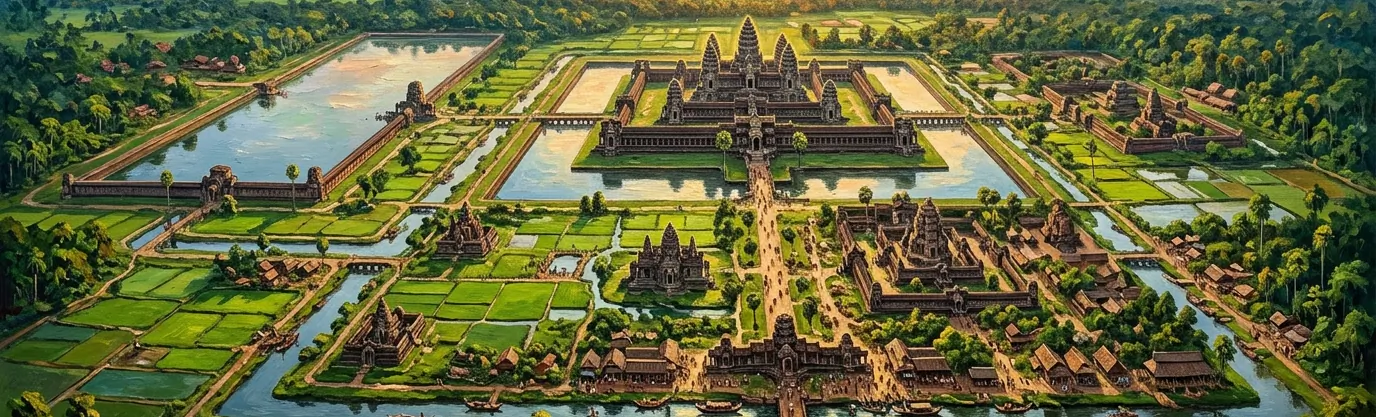
29.What massive engineering feature turned Cambodia's Angkor into the world's largest pre-industrial city?
Show Answer & Explanation
Correct Answer: C. Giant monsoon reservoirs called barays
Explanation: Between the ninth and fourteenth centuries CE, when London and Paris were muddy towns of fewer than 40,000 people, the Khmer Empire's capital of Angkor in Cambodia sprawled across nearly 400 square miles—roughly the footprint of modern Los Angeles—and supported up to 900,000 inhabitants!
Airborne LiDAR laser-scanning beneath the jungle canopy revealed how the Khmer survived Southeast Asia's extreme climate of four months of torrential monsoon rains followed by eight months of scorching drought: they reshaped the entire landscape into a colossal hydraulic machine centered on rectangular man-made reservoirs called *barays*.
The largest, the West Baray—dug entirely by hand with earthen dikes stretching five miles long by one-point-three miles wide—still holds over 14 billion gallons of water today, feeding an intricate grid of canals, temple moats, and overflow channels that allowed Khmer farmers to harvest rice three times a year!
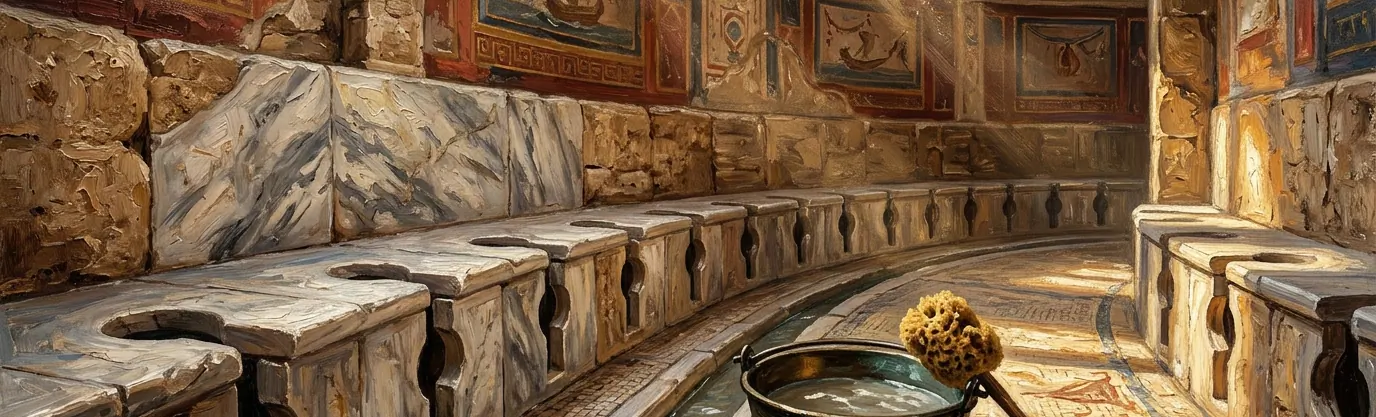
30.What did patrons of ancient Roman public bathhouse latrines share instead of toilet paper?
Show Answer & Explanation
Correct Answer: B. A vinegar-soaked sea sponge stick
Explanation: Ancient Rome was rightly proud of its marble-lined public bathhouses and multi-seat communal latrines (*foricae*), where ten to fifty citizens sat side-by-side on keyhole-shaped stone benches chatting about politics while continuous water from the aqueducts flushed waste down into the Cloaca Maxima sewer below.
Directly in front of the patrons' feet ran a shallow marble gutter of flowing water holding the *xylospongium* (or *tersorium*)—a natural Mediterranean sea sponge tied to the end of a wooden stick!
After wiping through the front keyhole slot of the marble seat, a Roman simply swished the communal sponge stick in the running water gutter or dunked it back into a shared bucket of salt water and vinegar for the next neighbor in line— inadvertently creating a highway for intestinal parasites across the Roman Empire!
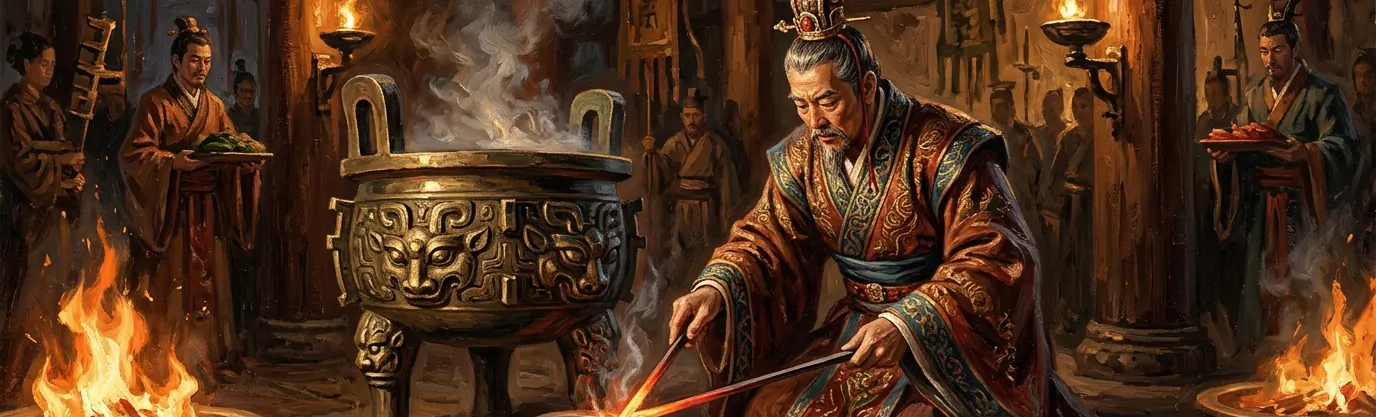
31.How did Shang Dynasty priests in 1200 BCE ask royal ancestors about the future?
Show Answer & Explanation
Correct Answer: D. Cracking turtle shells with fire
Explanation: In the late nineteenth century, villagers plowing fields near Anyang in China's Henan province kept digging up mysterious polished bone fragments covered in tiny carved symbols, which local apothecaries ground up into medicine and sold as "dragon bones."
In 1899, Chinese scholar Wang Yirong recognized that the symbols on those "dragon bones" were actually the oldest surviving Chinese writing—inscribed over 3,200 years ago by royal diviners of the Bronze Age Shang Dynasty!
Whenever a Shang king wanted to know if it would rain on Tuesday, whether a military campaign would succeed, or why he had a toothache, diviners carved the question onto a flat turtle plastron (belly shell) or ox shoulder blade, pressed a glowing-hot bronze poker into hollows on the back until the bone cracked with a loud *pop*, and interpreted the T-shaped cracks (*bu*) as the ancestors' answer!
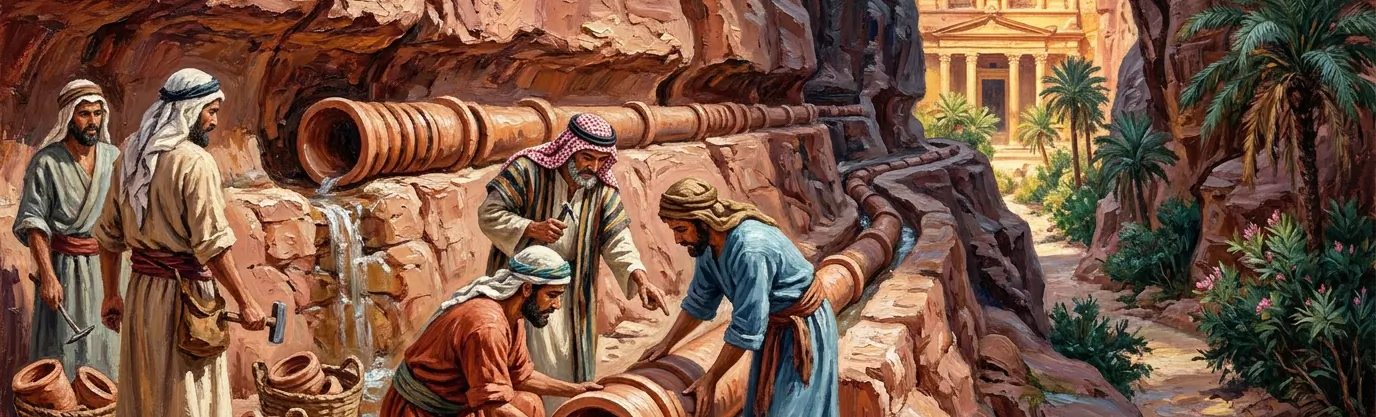
32.How did Petra's desert Nabataeans supply water to 30,000 residents and lush gardens?
Show Answer & Explanation
Correct Answer: A. Hidden cliff cisterns and pipes
Explanation: Carved directly into the rose-red sandstone cliffs of southern Jordan by the Nabataean Kingdom around the third century BCE, the desert city of Petra receives barely six inches of rain a year—usually in violent winter flash floods that race down rocky canyons and vanish in hours.
Yet ancient Greek and Roman visitors marveled that Petra's 30,000 citizens not only had abundant year-round drinking water for their caravans, they even maintained a massive 140-foot ornamental swimming pool and irrigated terraced oasis gardens in the middle of the desert!
Formerly nomadic masters of desert survival, Nabataean engineers built camouflaged flash-flood check dams, sand-settling basins, underground waterproofed rock cisterns, and over 125 miles of interlocking terracotta pipelines tucked into cliff ledges—engineered with a subtle air gap along the top of each pipe so pressurized water could flow at maximum volume without bursting the clay joints!
33.When islanders said Easter Island's 80-ton stone statues 'walked' to their platforms, how?
Show Answer & Explanation
Correct Answer: C. Rocking upright with three ropes
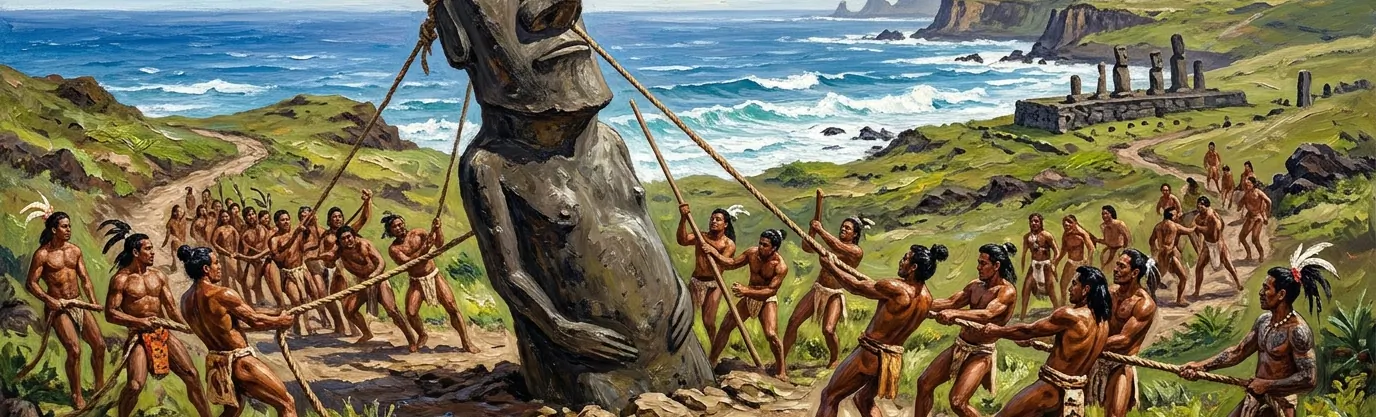
Explanation: For centuries, European visitors to Rapa Nui (Easter Island) assumed the island's nearly 900 monolithic volcanic tuff statues (*moai*)—weighing up to 80 tons and standing up to 33 feet tall—must have been dragged horizontally on wooden log rollers, deforesting the island in the process. When anthropologists asked indigenous Rapa Nui elders how the ancestors moved them up to eleven miles from the Rano Raraku quarry, the elders always gave the same answer: "The moai walked (*neke neke*)."
In 2012, archaeologists Terry Hunt and Carl Lipo noticed that unfinished moai abandoned along ancient roads had wide, rounded D-shaped bases and forward-leaning bellies that lowered their center of gravity, which made no sense if they were dragged flat on their backs.
Building a five-ton concrete replica, Hunt, Lipo, and National Geographic demonstrated that just eighteen people holding three hemp ropes—two teams on the sides rocking the statue left and right while a rear team steadied its head—could "walk" an upright moai down a road at 100 yards an hour, just like rocking a heavy refrigerator across a kitchen floor!
34.Why do the United Nations headquarters display a 1259 BCE clay tablet?
Show Answer & Explanation
Correct Answer: B. History's oldest surviving peace treaty
Explanation: In 1274 BCE, the two superpowers of the Bronze Age Near East—the Egyptian Empire under Pharaoh Ramesses II and the Hittite Empire of Anatolia under King Muwatalli II—clashed at the Battle of Kadesh in modern Syria in the largest chariot battle in history (involving up to 5,000 war chariots).
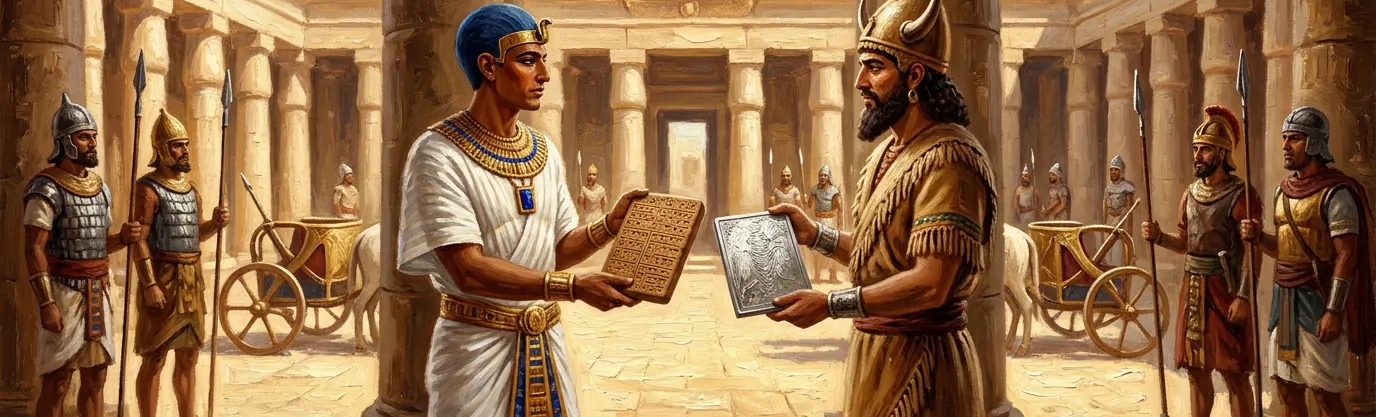
After fifteen years of costly stalemate following the battle, Ramesses II and the new Hittite King Hattusili III signed the Eternal Treaty of Kadesh in 1259 BCE—pledging eternal peace, a mutual defense alliance against third-party invaders, and the extradition of political fugitives!
Remarkably, archaeologists found both sides' copies: the Egyptian version carved in hieroglyphs on the walls of Karnak Temple at Luxor, and the Hittite version baked on cuneiform clay tablets in the royal archives of Hattusa (originally engraved on silver plaques)—making it the world's oldest surviving parity peace treaty, mounted outside the UN Security Council chamber in New York!
35.Which Mesopotamian city, not Babylon, likely held the famous Hanging Gardens?
Show Answer & Explanation
Correct Answer: D. Assyrian Nineveh under King Sennacherib
Explanation: Of all the Seven Wonders of the Ancient World, only one—the Hanging Gardens of Babylon—never yielded a single shred of archaeological evidence or mention in any surviving Babylonian royal inscription, even though King Nebuchadnezzar II recorded every brick of his temples and walls in obsessive detail.
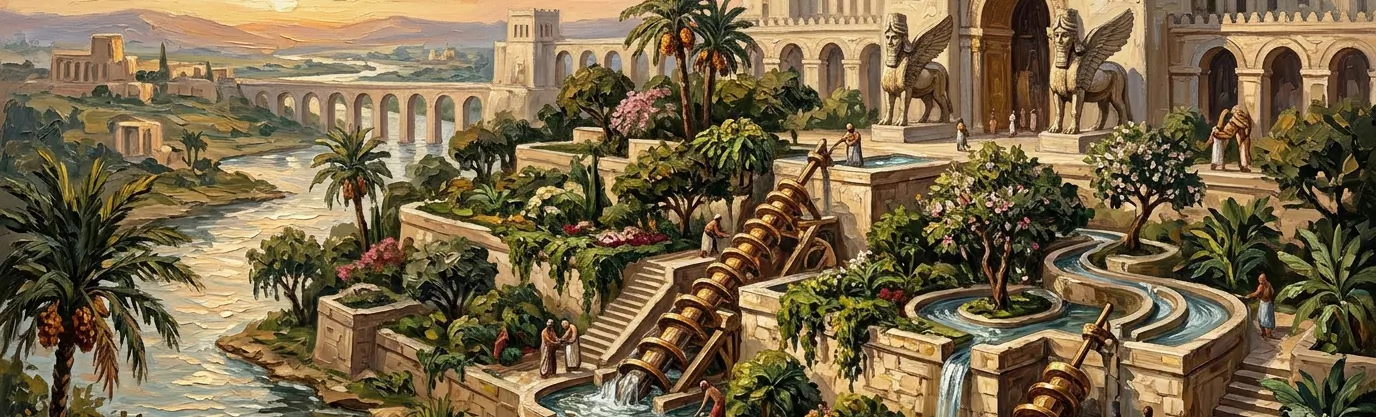
After twenty years of detective work deciphering cuneiform prism inscriptions and surveying ancient canal ruins, Oxford University Assyriologist Stephanie Dalley solved the 2,500-year-old mystery: later Greek historians had confused Babylon with the rival Mesopotamian capital of Nineveh (sometimes called "Old Babylon"), 300 miles to the north!
Around 700 BCE, Assyrian King Sennacherib built an astonishing terraced mountain garden beside his "Palace Without Rival" in Nineveh, explicitly boasting in his royal inscriptions that he engineered a 50-mile stone aqueduct with multi-arched valleys at Jerwan and cast giant bronze Archimedes-style water-raising screws—four centuries before Archimedes was born—to lift cascading water to the treetops!
36.Which West African civilization smelted iron and sculpted life-sized terracotta figures by 500 BCE?
Show Answer & Explanation
Correct Answer: A. Nigeria's ancient Nok culture
Explanation: In 1928, tin miners digging in the Jos Plateau near the village of Nok in central Nigeria unearthed a striking terracotta head of a monkey, followed in 1943 by the breathtaking "Jemaa Head"—revealing a previously unknown ancient West African civilization that flourished from roughly 1500 BCE to 200 CE.
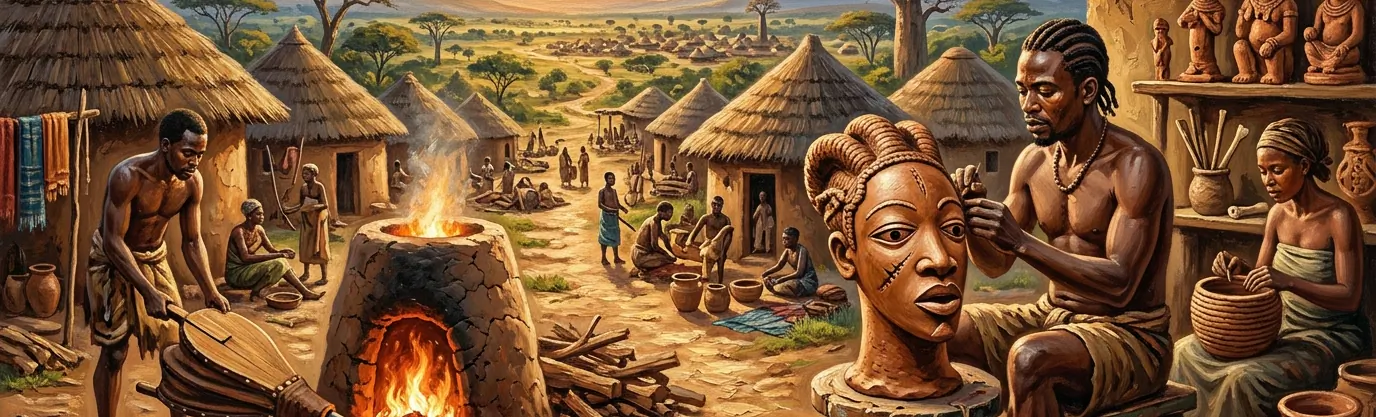
Centuries before Rome became an empire, Nok master sculptors hand-coiled coarse-grained local clay to create hollow, nearly life-sized terracotta human and animal statues featuring distinct triangular eyes, perforated pupils, elaborate braided hairstyles, and beaded jewelry, firing them in open-air kilns without a single crack.
Even more revolutionary, excavations of dozens of clay-shaft bloomery furnaces at Nok sites like Taruga proved that the Nok people jumped straight from the Stone Age to smelting high-grade iron around 550 BCE—completely skipping a Bronze or Copper Age to forge iron farming hoes, axes, and spears!
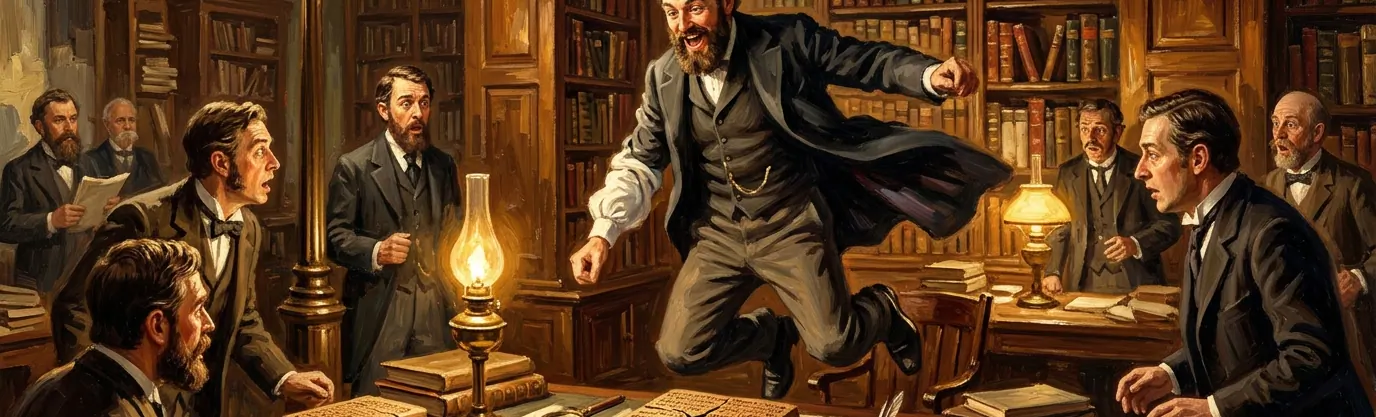
37.Why did British Museum translator George Smith suddenly strip off his clothes in 1872?
Show Answer & Explanation
Correct Answer: C. He deciphered Gilgamesh's flood story
Explanation: George Smith was a working-class London bank-note engraver who spent his lunch breaks staring so intently at cuneiform tablets in the British Museum that the keepers hired him to sort thousands of shattered clay fragments recovered from King Ashurbanipal's seventh-century BCE library at Nineveh.
On a November afternoon in 1872, while cleaning lime deposits off Tablet XI of the Epic of Gilgamesh—a Mesopotamian poem whose earliest Sumerian roots date back to 2100 BCE—Smith translated lines describing how the gods warned a man named Utnapishtim to build a giant pitch-sealed boat, load it with animals, survive a global deluge, and release a dove, a swallow, and a raven to find dry land!
Realizing he was the first human being in over two thousand years to read the Babylonian flood narrative—written more than a millennium before the oldest surviving Hebrew manuscripts of Genesis—Smith shouted "I am the first man to read that after two thousand years of oblivion!" and began running around the museum workroom in ecstatic excitement, stripping off his clothes as astonished clerks watched!
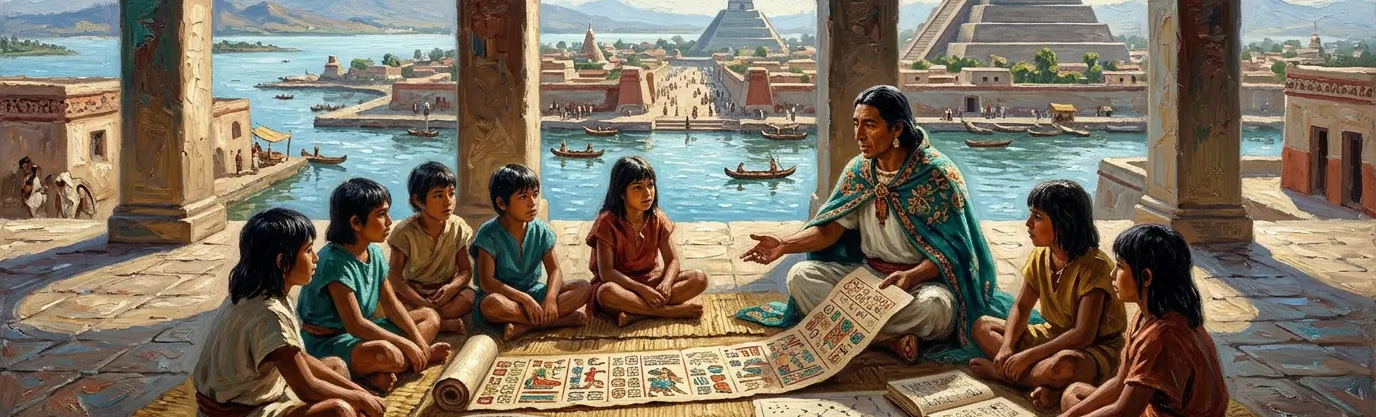
38.Which pre-modern empire required every child, noble or peasant, to attend school?
Show Answer & Explanation
Correct Answer: B. The Aztec Empire
Explanation: In sixteenth-century Europe, formal schooling was a luxury reserved for wealthy boys and future clergy—making the Spanish conquistadors' eyewitness accounts of the Aztec (Mexica) capital of Tenochtitlan in 1519 all the more extraordinary.
Under reforms expanded by Aztec rulers Itzcoatl and Moctezuma I in the fifteenth century, the Aztec Empire became one of the very first societies in human history to enforce mandatory, universal public education for every single boy and girl—whether the child of an emperor, a feather-worker, a farmer, or even an enslaved person!
Every neighborhood (*calpulli*) maintained a *cuicacalli* ("house of song" teaching sacred poetry, history, and dance to boys and girls ages 12–15) alongside a *telpochcalli* ("house of youth" teaching civic duty, trades, and martial arts to commoners), while noble children—and gifted commoners—studied astronomy, calendar mathematics, law, medicine, and pictographic codex painting at the elite *calmécac* academies!
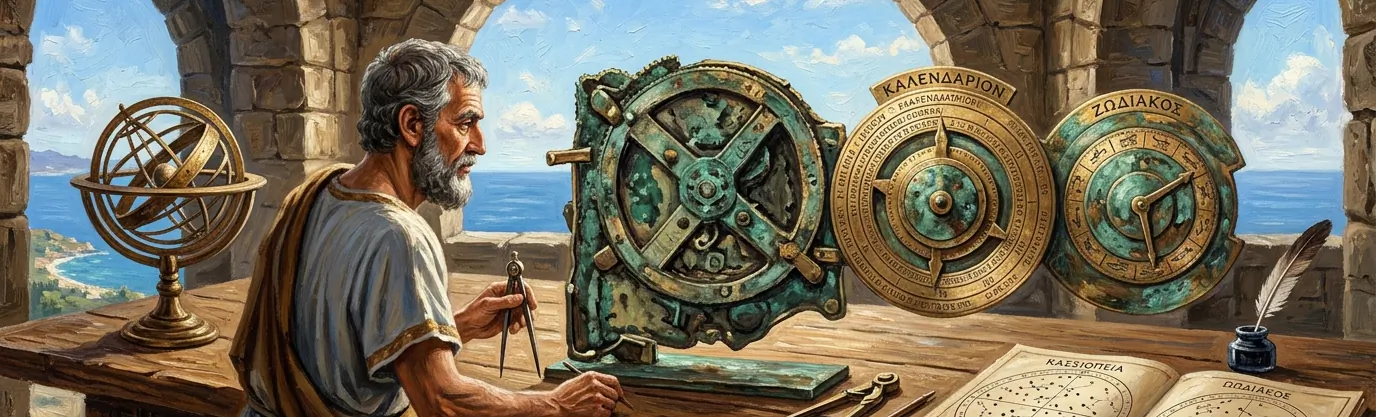
39.What did sponge divers recover from a first-century BCE Greek shipwreck off Antikythera?
Show Answer & Explanation
Correct Answer: D. A geared bronze astronomical computer
Explanation: In the spring of 1901, Greek sponge divers exploring a first-century BCE Roman cargo shipwreck 140 feet beneath the Aegean Sea off the tiny island of Antikythera hauled up marble statues, bronze horses, and a corroded, shoebox-sized lump of green bronze and rotting wood.
Months later at the National Archaeological Museum in Athens, the lump split open to reveal something historians believed could not possibly exist before fourteenth-century medieval cathedral clocks: precision-cut triangular-toothed bronze gearwheels inscribed with tiny ancient Greek astronomical text!
Modern 3D X-ray CT scans revealed that the Antikythera Mechanism (~150–100 BCE) contained at least thirty interlocking bronze gears operated by a hand crank—an analog mechanical computer that calculated the exact positions of the Sun, Moon, and five known planets, predicted solar and lunar eclipses to the hour using the Babylonian Saros cycle, and even tracked the four-year countdown to the ancient Olympic Games!

40.What happened around 6200 BCE to Stone Age Europe's heartland of Doggerland?
Show Answer & Explanation
Correct Answer: C. Melting glaciers drowned it underwater
Explanation: For thousands of years after the Last Glacial Maximum, Britain was not an island at all! Anyone could walk dry-shod from Yorkshire and Norfolk straight across to the Netherlands, Germany, and Denmark across a vast, low-lying green plain of rivers, marshes, oak forests, and lagoons that archaeologists call Doggerland.
Far from a barren land bridge, Mesolithic Doggerland was the richest hunter-gatherer heartland in northern Europe—which is why modern North Sea fishing trawlers and Dutch beachcombers routinely haul up barbed deer-antler harpoon points, flint axes, mammoth molars, and human skull fragments from the seafloor!
As the giant North American and Scandinavian ice sheets melted at the end of the Ice Age, rising sea levels gradually shrank Doggerland into a low-lying archipelago—until around 6200 BCE, the catastrophic Storegga Slide (an underwater continental-shelf landslide off Norway the size of Scotland) unleashed a sixty-foot mega-tsunami that drowned the last islands of Doggerland beneath the North Sea forever!
Did You Know? Fascinating Facts
- At Göbekli Tepe in southeastern Turkey, nomadic hunter-gatherers carved 18-foot-tall limestone pillars around 9600 BCE—more than 6,500 years before Stonehenge and before humanity had even invented pottery, metal tools, or settled farming!
- In the 9,000-year-old Neolithic settlement of Çatalhöyük in modern Turkey, up to 8,000 people lived in mud-brick houses packed wall-to-wall like a honeycomb with zero streets or ground-level doors—everyone walked across rooftops and climbed down wooden ladders through the ceiling!
- Around 1159 BCE at Deir el-Medina, artisans building Pharaoh Ramesses III's royal tombs in the Valley of the Kings staged the first recorded labor strike in human history when their monthly grain rations and skin-moisturizing ointments arrived late!