

Physics Trivia: 36 Quantum Paradoxes, Glowing Reactors & Mind-Bending Laws
Skip the chalkboard equations—explore 36 bizarre experiments, relativistic time shifts, and quantum quirks that make reality stranger than sci-fi.

1.Which breakthrough actually won Albert Einstein his 1921 Physics Nobel Prize?
Correct Answer: C. The photoelectric effect
Explanation: Ask almost anyone on the street why Albert Einstein won the Nobel Prize in Physics, and they will confidently shout "Relativity!" or "E = mc²!" Yet the Royal Swedish Academy of Sciences never awarded Einstein a prize for either Special or General Relativity, which conservative committee members still viewed as overly theoretical in the early 1920s.
Instead, when Einstein was finally awarded the delayed 1921 Nobel Prize in Physics, the official citation honored him specifically "for his services to Theoretical Physics, and especially for his discovery of the law of the photoelectric effect."
In his revolutionary March 1905 paper, Einstein proposed that light is not merely a continuous wave, but travels in discrete packets of energy (quanta, later called photons). When ultraviolet light hits a metal plate, individual photons knock electrons loose like billiard balls—a quantum insight that underpins modern solar panels, digital camera sensors, and night-vision goggles!

2.How many drops fell during ninety-five years of Queensland's Pitch Experiment?
Correct Answer: A. Only nine drops
Explanation: In 1927, Professor Thomas Parnell at the University of Queensland in Brisbane, Australia, heated a sample of coal-tar pitch—a black substance that feels rock-solid at room temperature and shatters into splinters if struck with a hammer—and poured it into a sealed glass funnel. After letting it settle for three years, he cut the funnel stem in 1930 to prove that "solid" pitch is actually a liquid with a viscosity roughly 230 billion times thicker than water.
Since 1930, the Pitch Drop Experiment has run continuously as the Guinness World Record holder for the world's longest-running laboratory experiment. Over the first 95+ years, each tar teardrop took between eight and fourteen years to form and fall—producing only nine drops in total (the ninth drop touched down in April 2014).
Most tragically comedic of all, because of poorly timed tea breaks, weekend nights, and a malfunctioning webcam glitch during the eighth drop in 2000, no human being has ever witnessed a single drop detach with their own eyes in real time!

3.How did Tanzanian student Erasto Mpemba rediscover hot water freezing faster?
Correct Answer: D. Making hot ice cream
Explanation: In 1963, thirteen-year-old Erasto Mpemba was making homemade ice cream with his classmates at Magamba Secondary School in Tanzania. Running late and worried he would lose the last spot in the school refrigerator's freezer tray, Mpemba shoved his boiling-hot milk-and-sugar mixture straight into the freezer without waiting for it to cool to room temperature.
An hour and a half later, Mpemba opened the freezer and discovered that his steaming-hot mixture had frozen into solid ice cream while his classmate's cool mixture right beside it was still thick liquid slush! When he asked his high-school physics teacher why, the teacher laughed and said, "That is Mpemba's physics, not universal physics."
Fortunately, visiting university physicist Denis Osborne took the boy seriously, ran controlled laboratory tests confirming that under specific conditions hot water really can freeze faster than cold water, and co-authored a landmark 1969 paper with Mpemba—immortalizing the counterintuitive phenomenon as the Mpemba Effect!

4.Why do underwater nuclear reactor cores glow with eerie blue light?
Correct Answer: B. Electrons outrunning light in water
Explanation: Look down into the cooling pool of a research nuclear reactor and you will see the submerged core radiating a haunting, neon sapphire-blue halo known as Cherenkov radiation—named after Soviet physicist Pavel Cherenkov, who won the 1958 Nobel Prize for explaining it.
While Einstein's special relativity dictates that nothing can travel faster than the speed of light in a vacuum (roughly 300,000 km/s), light slows down significantly to about 75% of that speed (225,000 km/s) when traveling through water.
High-energy beta particles (electrons) shot out by nuclear fission inside the reactor core blast through the cooling water at velocities faster than light can travel in that water! Just as a supersonic jet outrunning sound waves in air creates an acoustic sonic boom, charged electrons outrunning light in water create an optical "photonic boom"—emitting a cone of high-frequency blue and ultraviolet light!

5.What makes water droplets skitter frictionlessly across a scorching iron skillet?
Correct Answer: C. Insulating vapor cushion
Explanation: Sprinkle a few drops of water onto a mildly hot pan (around 100°C / 212°F) and they sizzle away into steam within a second. Yet if you heat that same cast-iron skillet well past 193°C (380°F), dropped beads of water suddenly stop hissing, pull into mercury-like spheres, and skitter effortlessly around the pan for minutes on end.
First described by German doctor Johann Gottlob Leidenfrost in 1756, the Leidenfrost Effect occurs when a surface is heated far above a liquid's boiling point (the Leidenfrost point). The bottom layer of the water droplet vaporizes instantaneously upon approaching the metal, creating a thin, pressurized cushion of steam roughly 0.1 millimeters thick.
Because steam is a poor conductor of heat, this levitating vapor hovercraft both eliminates surface friction and insulates the upper droplet from the scorching iron—keeping the water bead alive far longer than on a cooler pan!

6.Why did Erwin Schrödinger originally invent his famous boxed cat thought experiment?
Correct Answer: A. To mock quantum absurdity
Explanation: Pop culture treats "Schrödinger's Cat" as a proud mascot of quantum mechanics—celebrating the idea that a cat sealed inside a steel box with a radioactive atom, a Geiger counter, a hammer, and a vial of cyanide is literally both dead and alive until someone opens the lid.
In reality, Austrian physicist Erwin Schrödinger devised the scenario in 1935 (in correspondence with Albert Einstein) as a biting satire to expose what he saw as the ridiculousness of the Copenhagen interpretation of quantum mechanics!
Niels Bohr and Werner Heisenberg argued that subatomic particles exist in a blurry "superposition" of all possible states until measured. By chaining a single quantum radioactive decay to the fate of a macroscopic household pet, Schrödinger wanted to show how absurd it was to claim that uncertainty at the atomic scale could smear an everyday living creature into a half-dead, half-alive limbo.

7.What royal fraud was Archimedes investigating when he shouted 'Eureka' bathside?
Correct Answer: D. Silver-diluted gold crown
Explanation: According to the Roman architect Vitruvius, King Hiero II of Syracuse supplied a precise weight of pure gold to a master smith to craft a votive laurel-wreath crown for a temple. When the finished crown was delivered, it weighed the exact amount of gold given—yet rumors swirled that the goldsmith had pocketed some of the gold and secretly mixed in an equal weight of cheaper silver.
Ordered to uncover the truth without melting or scratching the sacred wreath, the Greek mathematician and physicist Archimedes pondered the puzzle until he stepped into an overflowing public bath. He noticed that the deeper his body sank, the more water spilled over the rim—realizing that submerged objects displace a volume of water exactly equal to their own volume.
Because silver is only about half as dense as pure gold, a crown diluted with silver would have to be bulkier than a pure gold lump of the same weight, and would therefore displace more water! Overjoyed, Archimedes reportedly leaped from the tub and sprinted home through Syracuse shouting "Eureka!" ("I have found it!").

8.What happens to light's speed when passing through a brilliant diamond?
Correct Answer: B. Slows by over half
Explanation: In the empty vacuum of outer space, light zips along at the ultimate cosmic speed limit of 299,792 kilometers per second (about 186,282 miles per second). However, the moment light enters a transparent material medium—such as air, water, glass, or gemstone crystals—its effective propagation speed drops as its electromagnetic waves interact with the electron clouds of the atoms inside.
Because diamond packs carbon atoms into an extraordinarily dense, rigid tetrahedral crystal lattice, it possesses one of the highest refractive indices ($n = 2.42$) of any natural transparent mineral on Earth.
When a beam of sunlight enters a diamond, its speed plummets by nearly 60%—down to just 124,000 kilometers per second! This extreme braking bends incoming light sharply and traps it inside via total internal reflection, giving cut diamonds their signature fiery rainbow sparkle.

9.What bizarre feat does liquid helium perform just above absolute zero?
Correct Answer: A. Climbs up container walls
Explanation: Cool ordinary helium-4 gas down to 4.2 Kelvin (-268.9°C) and it condenses into a colorless liquid bubbling quietly in a cryogenic flask. Cool it just a little further past the "lambda point" of 2.17 Kelvin (-270.98°C), however, and the boiling stops instantaneously: the helium transitions into a quantum superfluid with zero viscosity!
Because all the helium-4 atoms (which are bosons) collapse into the exact same macroscopic quantum ground state, they move in lockstep without any internal friction whatsoever. The liquid can squeeze effortlessly through microscopic pores that even gas molecules cannot penetrate.
Most astonishing of all, if you place an open glass beaker inside a bath of superfluid helium, a microscopic layer called a Rollin film (just 30 nanometers thick) defies gravity by creeping straight up the inside glass walls, flowing over the top rim, and dripping off the bottom until the levels equalize!

10.What did Léon Foucault's giant swinging Paris pendulum visibly prove in 1851?
Correct Answer: C. Earth's daily rotation
Explanation: For centuries after Copernicus and Galileo, astronomers knew Earth rotated on its axis once every 24 hours by watching the stars wheel overhead—yet nobody had ever demonstrated Earth's spin using a purely terrestrial experiment inside a closed room without looking at the sky.
In February 1851, French physicist Léon Foucault suspended a 28-kilogram brass-coated lead bob from a 67-meter-long steel wire attached to the high dome of the Panthéon in Paris. Beneath the swinging iron pointer, assistants smoothed a circular ring of damp sand.
Because a swinging pendulum maintains its plane of oscillation in space by inertia, as the pendulum swung back and forth, spectators watched in awe as the floor of the Panthéon slowly rotated clockwise underneath it—carving new notches in the sand every hour and giving humanity its first direct, mesmerizing visual proof of Earth's rotation!

11.How did chemist George de Hevesy hide two Physics Nobel medals from Nazis?
Correct Answer: D. Dissolved in orange acid
Explanation: When Nazi Germany invaded Denmark in April 1940, Danish physicist Niels Bohr faced an urgent crisis at his Copenhagen institute: German physicists Max von Laue (an outspoken anti-Nazi) and James Franck (who was of Jewish heritage) had entrusted their solid 23-karat gold Nobel Prize in Physics medals to Bohr's laboratory for safekeeping, and exporting gold out of Nazi Germany was a capital crime.
Bohr's colleague, Hungarian radiochemist George de Hevesy, rejected burying the medals because Nazi soldiers would easily sweep the grounds with metal detectors. Instead, as soldiers marched through Copenhagen's streets, Hevesy dropped both solid gold medals into a flask of aqua regia ("royal water")—a potent 3:1 mixture of hydrochloric and nitric acid capable of dissolving gold.
When Nazi troops ransacked Niels Bohr's institute looking for loot, they walked right past the unassuming jar of bright orange liquid sitting openly on a high laboratory shelf! After World War II ended, Hevesy returned to the untouched beaker, precipitated the dissolved gold back out of the acid, and sent the raw metal back to Stockholm, where the Nobel Foundation recast both medals and presented them anew in 1952.

12.By how much would smartphone GPS drift daily without Einstein's relativity corrections?
Correct Answer: B. About ten kilometers
Explanation: Many people assume Albert Einstein's theories of Special and General Relativity only matter near black holes or aboard futuristic starships. In fact, every time you order food delivery or use turn-by-turn navigation on your smartphone, you are relying directly on relativistic spacetime corrections!
Each of the 30+ Global Positioning System (GPS) satellites orbits 20,200 kilometers above Earth at roughly 14,000 km/h. According to Special Relativity, because the satellites move rapidly relative to us on the ground, their onboard atomic clocks tick slower than surface clocks by about 7 microseconds per day. Simultaneously, according to General Relativity, because gravity is four times weaker at that high altitude, the satellite clocks tick faster than ground clocks by 45 microseconds per day.
Combine both effects ($45 - 7 = +38$), and GPS satellite clocks gain a net 38 microseconds every single day! Because GPS calculates location by multiplying time signals by the speed of light, failing to engineer that 38-microsecond relativistic offset into the satellites would cause your phone's map position to drift off course by roughly 10 kilometers (6.2 miles) every 24 hours.

13.Why won't a penny dropped from the Empire State Building kill pedestrians?
Correct Answer: A. Low terminal velocity drag
Explanation: One of the oldest urban legends in New York City claims that if a tourist drops a penny from the 381-meter (1,250-foot) observation deck of the Empire State Building, the coin will accelerate until it pierces a pedestrian's skull or embeds itself in the concrete sidewalk below.
That scary scenario would only happen if Manhattan were encased inside an airless vacuum tube! In real atmosphere, a tiny, flat, 2.5-gram copper-plated zinc penny experiences intense aerodynamic drag and tumbles like a falling autumn leaf.
Within just 15 meters (50 feet) of leaving your fingers, upward air resistance completely balances the downward pull of gravity, locking the penny at a gentle terminal velocity of only 40 to 80 km/h (25 to 50 mph). When physicist Louis Bloomfield tested falling pennies using wind tunnels and helium balloons—even letting pennies hit his own hand—they felt like nothing more than a harmless tap or a falling bug!

14.What happens when intense sound waves collapse a tiny underwater gas bubble?
Correct Answer: C. It flashes star-hot light
Explanation: First observed in 1934 by German physicists H. Frenzel and H. Schultes while testing wartime marine sonar transducers in tanks of photographic developer fluid, sonoluminescence is the bizarre conversion of ordinary sound waves directly into flashes of visible light.
In laboratory single-bubble sonoluminescence, physicists trap a single microscopic air bubble inside a flask of water using standing ultrasonic sound waves. As the low-pressure half of the sound wave passes, the bubble expands; then, as the high-pressure acoustic wave slams into it, the bubble implodes inward at four times the speed of sound.
That violent supersonic compression concentrates acoustic energy by a factor of a trillion, heating the trapped gas molecules inside the collapsing bubble core to temperatures between 5,000 and 20,000 Kelvin—hotter than the surface of the Sun—and firing off a brilliant picosecond flash of blue-white ultraviolet light!

15.What aerodynamic phenomenon twisted Washington's Tacoma Narrows Bridge apart in 1940?
Correct Answer: D. Aeroelastic wind flutter
Explanation: On the morning of November 7, 1940—just four months after opening to traffic across Washington State's Puget Sound—the Tacoma Narrows suspension bridge (nicknamed "Galloping Gertie") began twisting wildly in a steady 42-mph (68-km/h) wind until its concrete-and-steel roadway tore itself to pieces on camera.
For decades, introductory physics textbooks mistakenly blamed the collapse on "simple forced mechanical resonance," claiming periodic wind gusts happened to match the bridge's natural frequency like an opera singer shattering a wineglass.
Modern fluid-dynamics research proved the culprit was actually aeroelastic torsional flutter! Because the bridge deck was built with solid 8-foot steel plate girders instead of open trusses that let wind pass through, each twist of the roadway altered the airflow to create self-reinforcing vortices that pumped more and more wind energy into the twisting motion until the steel suspension cables snapped.
16.What happened when physicist Anatoli Bugorski accidentally stuck his head inside a particle beam?
Correct Answer: B. He survived and finished PhD
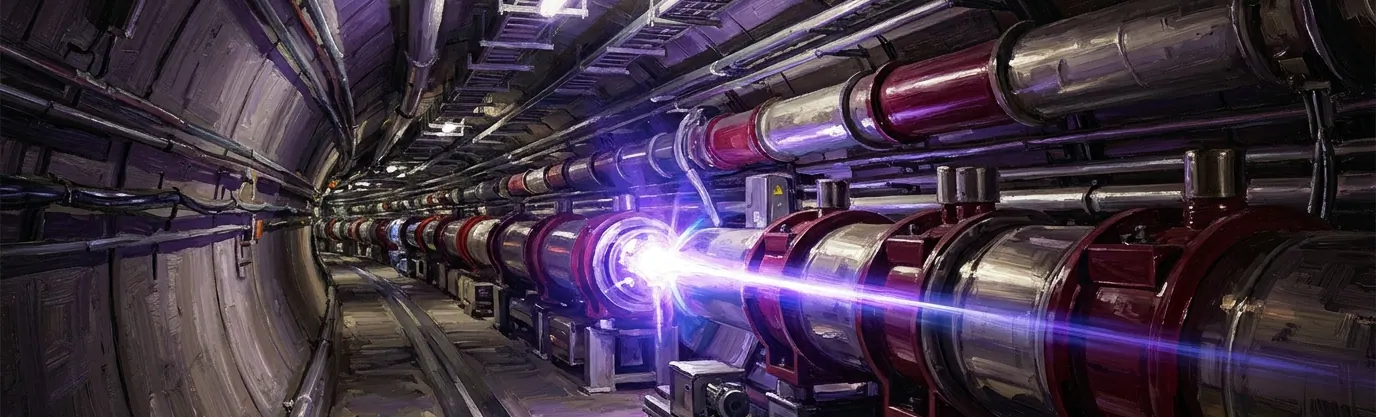
Explanation: On July 13, 1978, thirty-six-year-old Soviet researcher Anatoli Bugorski was leaning inside the U-70 synchrotron—the largest particle accelerator in the Soviet Union, located in Protvino—to inspect a malfunctioning piece of equipment when two safety interlocks and the warning light bulb failed simultaneously.
As Bugorski leaned in, a tightly focused beam of protons traveling at nearly the speed of light (carrying 76 gigaelectronvolts of energy) shot straight through the back of his skull, passed through his brain's occipital and temporal lobes, and exited out the left side of his nose! He felt zero pain, but reported seeing a flash "brighter than a thousand suns."
Doctors rushed him to a Moscow radiation clinic expecting him to die within days, as the beam delivered an estimated 200,000 to 300,000 rads along its narrow path (roughly 500 times a lethal whole-body dose). Because the proton beam was pencil-thin and deposited most of its energy after exiting his head, Bugorski miraculously survived with zero loss of intellect, completed his Ph.D. in physics, and worked for decades afterward as a particle-physics coordinator!

17.What held Otto von Guericke's famous copper spheres together against sixteen pulling horses?
Correct Answer: A. Surrounding atmospheric air pressure
Explanation: In 1654, German scientist, inventor of the vacuum pump, and Mayor of Magdeburg Otto von Guericke staged one of history's greatest theatrical physics demonstrations before Holy Roman Emperor Ferdinand III in Regensburg.
Von Guericke cast two hollow copper hemispheres about 50 centimeters (20 inches) in diameter with smooth, greased leather-ringed rims. Without using any bolts, latches, or glue, he placed the two halves together to form a globe and used his newly invented piston pump to suck the air out from inside.
Next, two teams of eight draft horses (sixteen horses in total) were harnessed in opposite directions and whipped at full strength—yet they could not pull the two unbolted copper bowls apart! Only when von Guericke turned a small brass tap to let ordinary air hiss back inside did the two hemispheres fall apart under their own weight, proving that we live at the bottom of a heavy ocean of atmospheric pressure pressing inward with over 4,000 pounds of force.

18.Why can atoms never stop jiggling completely, even at absolute zero?
Correct Answer: C. Quantum zero-point energy
Explanation: In classical nineteenth-century thermodynamics, temperature is simply a measure of the average kinetic jiggling of atoms and molecules. Therefore, classical physicists assumed that if you cooled matter all the way down to absolute zero (0 Kelvin, or -273.15°C), every atom would freeze dead still with zero motion and zero energy.
Quantum mechanics shattered that classical assumption! According to Werner Heisenberg's Uncertainty Principle, it is physically impossible for any particle to simultaneously possess both an exact, fixed position in space and an exact momentum of zero.
If an atom ever stopped moving completely at a fixed spot, both its position and momentum would be known with 100% precision—violating the fundamental laws of quantum physics! Consequently, even at absolute zero, all atoms retain an irreducible minimum quantum jiggle known as zero-point energy.

19.How tiny are the spacetime length shifts measured by LIGO's four-kilometer lasers?
Correct Answer: D. Fraction of a proton
Explanation: In 1916, Albert Einstein predicted that catastrophic cosmic collisions—such as two black holes spiraling together—would send ripples of stretching and squeezing spacetime across the universe called gravitational waves. However, Einstein himself believed the ripples would be so infinitesimally weak by the time they reached Earth that humans would never build an instrument sensitive enough to detect them.
Ninety-nine years later, on September 14, 2015, the twin Laser Interferometer Gravitational-Wave Observatory (LIGO) detectors in Hanford, Washington, and Livingston, Louisiana, proved Einstein's pessimism wrong by recording the collision of two black holes 1.3 billion light-years away.
To catch that passing wave, LIGO bounces laser beams back and forth along two perpendicular 4-kilometer-long vacuum tubes and measures interference shifts in arm length of just $10^{-19}$ meters—one ten-thousandth the diameter of a single proton! That is equivalent to measuring the distance to the nearest star outside our solar system (Alpha Centauri, 4.3 light-years away) to within the width of a single human hair.

20.What physics phenomenon makes wintergreen hard candies spark blue when crushed in darkness?
Correct Answer: B. Triboluminescence crystal fracturing
Explanation: Stand in front of a mirror in a pitch-black closet, let your eyes adjust, and crunch down on a Wint-O-Green Life Savers hard candy with your mouth open: you will see miniature bolts of eerie blue-green lightning flash between your teeth!
This phenomenon is called triboluminescence (from the Greek tribein, "to rub," and the Latin lumen, "light"). When you fracture asymmetric sucrose sugar crystals with your teeth or pliers, opposite electrical charges are ripped apart across the breaking crystal planes. Millions of electrons leap across the tiny gap to neutralize the charge, colliding with nitrogen molecules in the surrounding air and causing the nitrogen to emit tiny bursts of ultraviolet and faint blue light.
Why do wintergreen candies glow ten times brighter than plain peppermint candies? Because wintergreen flavoring contains methyl salicylate—a fluorescent molecule that absorbs the invisible ultraviolet light generated by the cracking sugar and re-emits it as a bright, visible neon-blue flash!

21.How do cosmic-ray muons survive the trip down through Earth's atmosphere?
Correct Answer: A. Relativistic time dilation slows decay
Explanation: When high-energy cosmic rays from deep space slam into atoms in Earth's upper atmosphere about 15 kilometers (9 miles) above the ground, they create showers of unstable subatomic particles called muons—heavy cousins of the electron that travel downward at 99.5% of the speed of light.
Here is the puzzle: at rest in a laboratory, a muon has an average lifespan of just 2.2 microseconds (millionths of a second) before decaying into an electron and neutrinos. Even moving at nearly the speed of light, in 2.2 microseconds a muon should only be able to travel about 660 meters (less than half a mile) before vanishing—meaning almost none should ever reach sea level!
Yet detectors on the ground record millions of muons hitting Earth's surface every minute! Because the muons are traveling at 99.5% of the speed of light, Einstein's special relativity slows down their internal clocks relative to us by a factor of ten (time dilation), while from the muon's own perspective, Earth's 15-kilometer atmosphere is squashed down to just 1.5 kilometers (length contraction)—letting them easily complete the journey!

22.What happens to water at its thermodynamic triple point in a vacuum?
Correct Answer: D. Boils and freezes simultaneously
Explanation: In everyday life at standard sea-level atmospheric pressure, liquid water freezes into solid ice at 0°C and boils into water vapor at 100°C—two opposite ends of the thermometer. However, temperature and pressure work together to determine which phase of matter is stable.
If you place liquid water inside a sealed vacuum chamber and lower the pressure to exactly 611.657 Pascals (roughly 0.006 atmospheres) while holding the temperature at precisely 0.01°C (273.16 Kelvin, or 32.018°F), you hit the thermodynamic Triple Point of Water.
At that exact razor's-edge coordinate of temperature and pressure, all three phases of matter—solid ice, liquid water, and gaseous steam—exist in simultaneous thermodynamic equilibrium! Watching a triple-point flask looks like pure sorcery: the water violently boils with bubbles of vapor while simultaneously freezing over into a crust of solid ice crystals right before your eyes.

23.Why do passengers inside a metal airplane survive direct lightning strikes unharmed?
Correct Answer: C. Outer skin conducts charge around
Explanation: Every commercial airliner is struck by lightning an average of once or twice a year while flying through storm clouds, and automobiles on the highway are occasionally hit by bolts carrying 300 million volts. Yet passengers buckled inside metal airplanes and hardtop cars almost never feel even a mild static shock.
A persistent myth claims that a car's rubber tires insulate it from the ground—which makes no sense when you realize that a lightning bolt has already jumped through miles of insulating air, so four inches of rubber wouldn't stop it for a microsecond (and airplanes flying at 35,000 feet aren't touching the ground at all!).
Instead, both vehicles act as a Faraday Cage—invented by English physicist Michael Faraday in 1836. When an external electrical discharge hits a hollow metallic conductor, mutual repulsion among electrons forces all the electrical charge to travel exclusively along the outer aluminum or steel skin, canceling out the electric field inside the cabin and exiting harmlessly off the tail or wheel rim!

24.Roughly how much would a single teaspoon of neutron star matter weigh?
Correct Answer: B. Billions of tons
Explanation: Ordinary matter is almost entirely empty space: if you inflated the nucleus of a hydrogen atom to the size of a marble on the 50-yard line of a football stadium, its orbiting electron would be a gnat buzzing out past the top row of the bleachers.
When a massive star (8 to 20 times heavier than our Sun) runs out of nuclear fuel and explodes as a supernova, gravity crushes its core with such unimaginable violence that electrons are forced right into protons, merging into a solid ball of pure neutrons just 20 kilometers (12 miles) wide—a city-sized neutron star containing more mass than our entire Sun!
With all atomic empty space squeezed out so neutrons touch shoulder-to-shoulder at nuclear density ($4 imes 10^{17} ext{ kg/m}^3$), a single five-milliliter teaspoon of neutron star material would weigh between 1 billion and 4 billion metric tons—roughly the same weight as Mount Everest or every single car, truck, and human being on Earth combined!

25.What optical property lets transparent Iceland spar calcite crystals create double images?
Correct Answer: A. Double refraction birefringence
Explanation: Place a transparent rhombohedral crystal of Iceland spar (optical-grade calcium carbonate calcite) over a page of text, and every word underneath splits into two crisp, overlapping images! Rotate the crystal like a dial, and one image stands stationary while the second image orbits in a circle around it.
First documented in 1669 by Danish scientist Rasmus Bartholin, this phenomenon is called birefringence (or double refraction). Because the asymmetric carbonate ions inside the calcite crystal lattice are arranged differently along different axes, an incoming unpolarized beam of light splits into two separate rays polarized at right angles to each other—"ordinary" and "extraordinary" rays—that travel through the crystal at two different speeds and bend at two different angles!
Even before seventeenth-century physicists studied Iceland spar to discover the polarization of light, Viking navigators likely used these birefringent crystals as "sunstones" (sólarsteinn) to locate the polarized ring of sunlight through thick North Atlantic fog and clouds.

26.What pushes two uncharged metal plates together inside an empty quantum vacuum?
Correct Answer: D. Virtual particle vacuum pressure
Explanation: In classical physics, a perfect vacuum—empty space stripped of every single atom, molecule, and photon—contains literally nothing. If you hang two uncharged, non-magnetic metal mirrors a fraction of a micrometer apart inside that classical vacuum, no force besides minuscule gravity should act between them.
In 1948, however, Dutch physicist Hendrik Casimir predicted that a quantum vacuum is never truly empty: it seethes with "virtual particles" and electromagnetic zero-point waves popping into and out of existence across every possible wavelength.
When two uncharged conductive plates are placed nanometers apart, long-wavelength virtual photons cannot fit into the narrow gap between the mirrors, whereas all wavelengths can still push against the outside surfaces of the plates! Because more virtual photons bombard the outsides than fit inside the gap, the quantum vacuum pushes the two plates together—a measurable force known as the Casimir Effect!

27.Why doesn't the Coriolis effect dictate which way your bathroom sink drains?
Correct Answer: C. Basin is far too small
Explanation: From episodes of The Simpsons to roadside tourist traps straddling the Equator, millions of people believe that Earth's rotation via the Coriolis force makes bathroom sinks and toilets spin counterclockwise in the Northern Hemisphere and clockwise in the Southern Hemisphere.
While the Coriolis effect is 100% real and dictates the rotation of giant hurricanes and ocean gyres spanning hundreds of kilometers, Earth rotates only once every 24 hours—twenty thousand times slower than a carousel! Across a half-meter bathroom sink, the Coriolis acceleration is roughly ten million times weaker than gravity.
Because your sink basin is tiny compared to the planet, the direction your bathwater drains is determined entirely by the angle of the faucets, the slight asymmetry of the porcelain bowl, and residual currents left over from filling the sink. Only in custom-built, perfectly symmetrical two-meter laboratory tanks allowed to settle motionless for 24 hours before pulling a plug from below can physicists detect Earth's rotation in draining water!

28.Where did astronaut David Scott drop a hammer and falcon feather simultaneously?
Correct Answer: B. On the Moon's surface
Explanation: Nearly four hundred years ago, Italian physicist Galileo Galilei overturned Aristotle's ancient claim that heavy objects fall faster than light ones, demonstrating that in the absence of air resistance, gravity accelerates all falling masses at the exact same rate regardless of weight.
At the end of the final moonwalk of NASA's Apollo 15 mission on August 2, 1971, Commander David Scott stood in front of the live television camera on the airless plains of Hadley Rille holding a 1.32-kilogram aluminum geological hammer in his right hand and a 0.03-kilogram falcon feather (a nod to the Apollo 15 Lunar Module Falcon) in his left.
When Scott opened both gloved hands simultaneously in the lunar vacuum, the feather didn't flutter or drift: both the hammer and the feather dropped in lockstep and hit the lunar soil at the exact same instant, prompting Scott to exclaim across 380,000 kilometers of space, "How about that! Mr. Galileo was correct in his findings!"

29.From which James Joyce novel did Murray Gell-Mann borrow the word 'quark'?
Correct Answer: A. Finnegans Wake
Explanation: In 1964, American physicist Murray Gell-Mann (and independently George Zweig, who called them "aces") revolutionized particle physics by proposing that protons and neutrons are not fundamental indivisible balls, but are each built from trios of fractional-charge elementary particles.
At first, Gell-Mann only had a spoken sound in mind—pronounced "kwork"—to name these playful building blocks of matter. Soon afterward, while flipping through James Joyce's notoriously complex, multilingual 1939 modernist novel Finnegans Wake, he stumbled across the surreal sentence: "Three quarks for Muster Mark!"
Because protons and neutrons are composed of exactly three quarks, Joyce's line was a match made in heaven! Physicists kept the whimsical literary spirit alive as they discovered all six "flavors" of quarks: Up, Down, Strange, Charm, Bottom, and Top—held together by particles playfully named gluons.

30.How do you instantly shatter a hammer-proof glass Prince Rupert's drop?
Correct Answer: D. Flick its thin tail
Explanation: Brought to King Charles II's Royal Society in London in the 1660s by Prince Rupert of the Rhine, a Prince Rupert's Drop is made through the simplest recipe imaginable: a glassblower drips a molten glob of red-hot glass straight into a bucket of cold water, where it cools into a tadpole-shaped glass droplet with a bulbous head and a long, wispy tail.
Because the cold water freezes the outer skin of the glass bulb immediately while the molten interior cools and contracts more slowly, the inner core pulls fiercely inward on the outer shell—locking the bulb under compressive stresses up to 700 megapascals (nearly 7,000 times atmospheric pressure). You can bash the glass bulb head with a steel sledgehammer or even shoot it with a .22-caliber bullet and it will not break!
However, if you gently pinch or nick the hair-thin glass tail with your fingers, you release the locked-in tensile stress: a fracture wave rips from the tail to the bulb at 1,650 meters per second (five times the speed of sound in air), exploding the entire glass drop into fine powder in microseconds!

31.What effect expels magnetic fields so superconductors levitate effortlessly in midair?
Correct Answer: C. The Meissner effect
Explanation: When Dutch physicist Heike Kamerlingh Onnes cooled mercury wire to 4.2 Kelvin in 1911, he discovered superconductivity: electrical resistance dropped to absolute zero, allowing an electric current to circulate inside a superconducting ring forever without losing a single watt of heat.
In 1933, German physicists Walther Meissner and Robert Ochsenfeld discovered that superconductors are far more than just perfect conductors—they are also perfect diamagnets! As a material transitions into its superconducting state, it actively expels all magnetic field lines from its interior, a phenomenon known as the Meissner Effect.
When you place a rare-earth magnet above a ceramic superconductor chilled with liquid nitrogen, persistent surface currents inside the superconductor create a mirror-image magnetic field that repels the magnet—locking it in midair via quantum flux pinning so it hovers or glides upside down along a magnetic track!

32.What simple prop did physicist Richard Feynman use to explain Challenger's failure?
Correct Answer: B. A glass of ice water
Explanation: Following the tragic January 28, 1986 loss of the Space Shuttle Challenger 73 seconds after liftoff on a freezing 28°F (-2°C) Florida morning, Nobel Prize-winning physicist Richard Feynman was appointed to the Presidential Rogers Commission investigating the disaster.
While bureaucratic managers presented reams of evasive charts claiming the solid rocket boosters' rubber O-ring seals were safe in cold weather, Feynman decided to cut through the jargon during a live televised congressional hearing on February 11, 1986. He took a sample piece of the booster's black rubber O-ring, squeezed it inside a small metal C-clamp from a hardware store, and dunked it into his cup of restaurant ice water for a few minutes.
Pressing his microphone button, Feynman pulled the cold rubber out of the water, loosened the clamp, and held it up for the cameras: at 32°F, the rubber stayed pinched flat and failed to spring back to seal a gap! In thirty seconds with a glass of ice water, he delivered the most famous public physics demonstration of the twentieth century.

33.If atmosphere scatters violet light most, why does daytime sky look blue?
Correct Answer: A. Sun and eyes favor blue
Explanation: Every student learns that Earth's daytime sky is blue because of Rayleigh scattering: tiny nitrogen and oxygen molecules in the atmosphere scatter short wavelengths of sunlight much more strongly than long red and orange wavelengths (specifically, scattering scales inversely with the fourth power of wavelength, $lambda^{-4}$).
Yet a clever physics student will immediately spot a paradox: violet light has an even shorter wavelength (around 400 nanometers) than blue light (around 470 nanometers), meaning the atmosphere actually scatters violet light nearly twice as strongly as blue! Why doesn't the sky look bright purple?
The answer combines astrophysics with human biology: first, the Sun's surface spectrum emits far more blue photons than violet photons to begin with; second, human retinas rely on three types of color-sensing cone cells (Red, Green, and Blue), and the sky's mix of scattered violet and blue wavelengths stimulates both our blue cones and a tiny touch of our red and green cones—which our brain integrates as pale, luminous sky blue!
34.Roughly how often does an ordinary potassium-rich banana emit an antimatter positron?
Correct Answer: D. About once every hour
Explanation: Antimatter sounds like exotic fuel found only inside the warp cores of the USS Enterprise or deep inside CERN's multi-billion-dollar particle colliders. In reality, you likely have an antimatter generator sitting right on your kitchen counter in the fruit bowl!
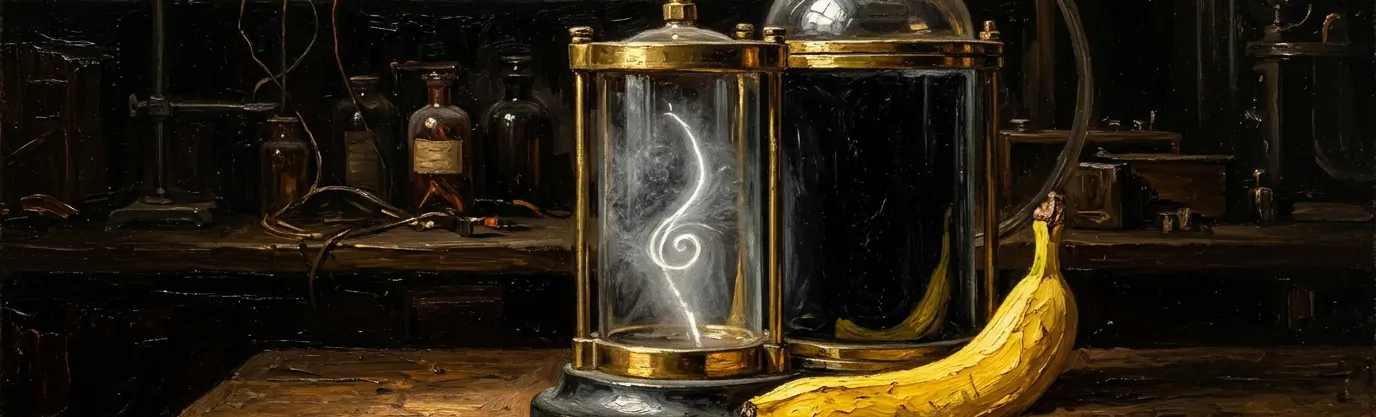
Bananas are famously rich in potassium, and about 0.0117% of all natural potassium on Earth is the mildly radioactive isotope Potassium-40 ($^{40} ext{K}$). While Potassium-40 decays into calcium by emitting an ordinary electron 89% of the time, roughly 0.001% of its decays occur via beta-plus emission—spitting out an anti-electron, better known as an antimatter positron!
In an average-sized banana containing about 450 milligrams of potassium, roughly 15 Potassium-40 nuclei decay every second—and about once every 75 minutes (roughly 15 to 20 times a day), your banana shoots out a real antimatter positron that immediately annihilates with a nearby electron in a harmless microscopic flash of gamma rays!
35.Why do spinning wingnuts flip end-over-end every few seconds in zero gravity?
Correct Answer: C. Unstable intermediate rotation axis
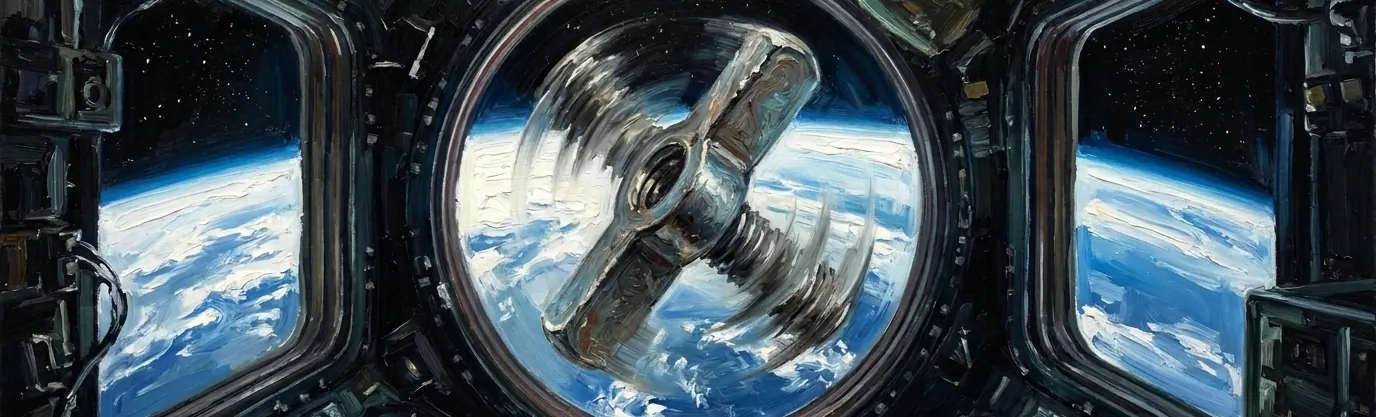
Explanation: In 1985, while unpacking supply crates aboard the Soviet Salyut 7 space station, cosmonaut Vladimir Dzhanibekov spun a metal wingnut off a threaded bolt in zero gravity and watched something eerie: the spinning T-shaped handle glided forward smoothly for a few inches, suddenly flipped 180 degrees to point backward while continuing to spin, glided a little farther, and flipped 180 degrees back again like clockwork!
The Soviet space program initially kept the "Dzhanibekov Effect" classified for years, as rumors circulated that if a spinning wingnut flipped periodically in space, Planet Earth itself might one day flip upside down!
Fortunately, Earth is safe (it rotates around its maximum-inertia axis), and the wingnut's behavior is fully explained by classical rigid-body mechanics as the Tennis Racket Theorem (or Intermediate Axis Theorem). Any rigid object with three different moments of inertia can spin stably around its longest and shortest axes, but rotation around the middle (intermediate) axis is inherently unstable—causing tiny wobbles to amplify exponentially until the object flips 180 degrees!
36.How many ghostly solar neutrinos zip through your thumbnail every single second?
Correct Answer: B. Tens of billions
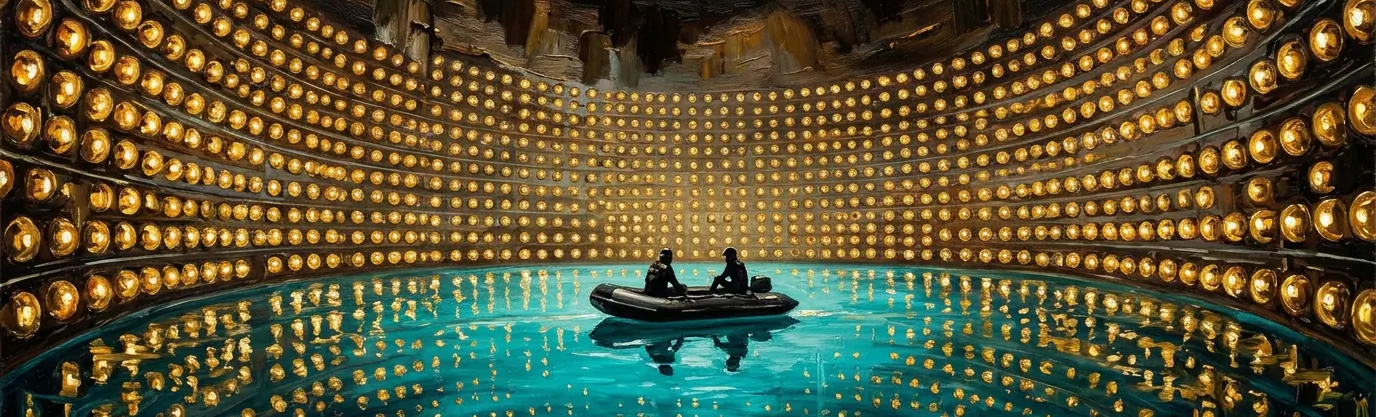
Explanation: Hold up your thumb—whether it is noon in bright sunshine or midnight inside a windowless basement, roughly 65 billion solar neutrinos forged in the nuclear fusion furnace at the core of the Sun are passing straight through every square centimeter of your thumbnail every single second!
First proposed by Wolfgang Pauli in 1930 to rescue the law of conservation of energy in beta decay, neutrinos ("little neutral ones") carry zero electrical charge, have an almost unimaginably tiny mass, and do not interact with the strong nuclear force or electromagnetism at all.
Because neutrinos only feel gravity and the ultra-short-range weak nuclear force, ordinary solid matter is practically transparent to them: at night, those 65 billion neutrinos per square centimeter zip straight up through 12,742 kilometers of solid Earth rock and iron core before passing through your bed and body without hitting a single atom! In fact, a typical solar neutrino could fly through a solid wall of lead one light-year (9.5 trillion kilometers) thick with a 50% chance of never colliding once.